

The most useful Lake Hartwell strategies for the 2026 Mercury B.A.S.S. Nation Championship begin with a simple fact: this is not just another fall tournament. From November 18-21, 2026, the event is scheduled for Lake Hartwell, launching from Green Pond Landing in Anderson County, South Carolina. Bassmaster reported that the champion earns a place in the Progressive Bassmaster Elite Series, while the top three finishers qualify for the 2027 Bass Pro Shops Bassmaster Classic Bassmaster event notice.
Lake Hartwell Strategies Start With Stakes
Lake Hartwell Strategies And Qualification Pressure
The championship format changes how competitors should read the lake. A single good morning can move an angler up the board, but the larger prize structure rewards repeatable decision-making across four scheduled competition days. That means practice cannot be built only around one visible school, one productive dock line, or one early bite window. Competitors need patterns that can survive pressure, changing light, and the late-November shift between shallow movement and deeper holding areas.
For the Nation field, this event also sits at a crossroads in tournament fishing history. The B.A.S.S. Nation has long served as a route from state and regional competition into the sport’s highest professional levels. The 2026 championship carries that same ladder effect, with Elite Series entry and Classic qualification tied directly to the final standings. That should make risk management as important as lure selection.
What Is Verified About The Venue
The verified venue profile points toward variety rather than a single-lane tournament. Lake Hartwell is listed at 56,000 acres, with largemouth bass and spotted bass supported by deep timber, rocky points, creek arms, and major structure. Those details matter because a mixed bass fishery can punish an angler who commits too early to one species, one depth, or one section of the lake.
That is why the better pre-event frame is not “shallow or deep.” It is “which available structure keeps bait and catchable bass closest together after several days of practice and tournament traffic?” For anglers studying comparable event logic, a related analysis of Hartwell tournament value makes the same broader point: scale and access give the lake room to separate efficient pattern fishing from isolated bites.
Low Water Changes The Tournament Map
Access And Cover Are Not The Same
As of October 29, 2026, the research notes place Lake Hartwell around 647.8 feet, well below the roughly 660-foot full pool reference. That kind of water-level context is not a small detail. A low lake can expose shallow cover, reduce the usefulness of some shoreline targets, and make certain stretches less efficient to fish. The reported level and lake-condition snapshot are listed by Crook & Hook R’s Hartwell page.
Low water does not automatically make the fishing worse. It can make the choices clearer. If shoreline brush, shallow wood, or bank-related targets lose depth, anglers may need to treat them as short-window opportunities rather than all-day areas. A cast may still be worth making if bait is present, but the boat position and approach become more exact. In low water, a productive target may be easier to see and easier for the whole field to find.
Main-Lake Structure Gets A Longer Look
The research notes point competitors toward main-lake points, humps, creek mouths, timber, brush, and longer structural features. That does not mean every angler should abandon the creeks. It means the better question is whether a creek has the same ingredients as the main lake: bait, depth change, and a place for bass to feed without leaving safety. Long points that touch deeper water can become especially important when fall fish shift between feeding bursts and holding positions.
For Lake Hartwell strategies, the main-lake-versus-creek decision should be tested against time. A pattern that takes too long to repeat may not hold up in a championship setting. If an angler needs to run too many isolated places to build a limit, the pattern may be fragile. If several similar points or humps produce the same quality of bite, that becomes a stronger tournament plan.
Fall Pattern Choices For Competitors
Surface Clues Need Confirmation
The late-November window often encourages competitors to watch for surface activity, especially where shad or blueback herring are part of the forage picture described in the research. Walking baits, topwater plugs, flukes, and jerkbaits all fit that kind of visible feeding scenario. The caution is that surface activity can be misleading. Schooling fish may not be black bass, and not every breaking group creates tournament weight.
The practical Lake Hartwell strategies here are evidence-based: use the surface bite as a locator, not as the whole plan. If a topwater fish reveals a point, hump edge, or brush-related school, the follow-up presentation may be more important than the first cast. A jerkbait over suspended fish, a soft plastic around brush, or a finesse rig near timber can turn a short feeding window into a more durable area.
Finesse Keeps A Limit Alive
The research notes also identify deeper docks, brush piles, standing timber, and submerged structure in the 15- to 30-foot range as important fallback zones when surface activity fades. That is the kind of depth band where drop-shot rigs, shaky heads, and compact soft plastics can help an angler keep catching bass after the fast bite slows. This is not glamorous fishing, but championship events are often shaped by the fish that fill a limit while the field waits for another schooling flurry.
- Early and late: test walking baits, topwater plugs, and jerkbaits around visible bait and active points.
- Midday: check brush, timber, deeper docks, and submerged structure with slower presentations.
- Low-water areas: approach shallow cover carefully and avoid assuming exposed cover still holds enough depth.
- Color choices: keep baitfish tones and darker low-light silhouettes available, as noted in the research.
The key is not carrying every bait in the boat. It is building a rotation that answers what the lake is showing. If bait is high and bass are chasing, move quickly. If the lake looks quiet, slow down and make the deeper targets prove whether they are holding fish.
Anderson County Impact Around Green Pond Landing
A Concentrated Launch Point
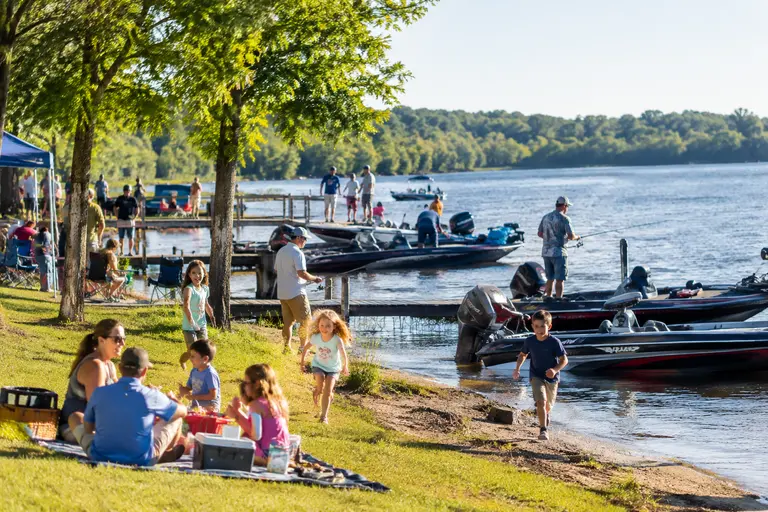
Green Pond Landing gives this championship a defined local center. That matters for Anderson County because the verified event footprint is not spread across a vague region; it is tied to a named launch site and a nationally recognized B.A.S.S. championship. Practice days, launch routines, weigh-in operations, and support activity are expected to be centered around that access point during the event window.
For local anglers, the community impact is practical as much as promotional. A championship field can increase pressure on popular areas, especially the obvious points, creek mouths, and visible schooling zones. Recreational fishermen who use the lake during the same period should expect tournament traffic around high-percentage structure and should give competitors enough room to work safely. That is not a rule claim; it is basic shared-water etiquette.
A Cautious Reading Of Tourism Value
Sports tourism language can get overstated, so the safest analysis stays with what is verified. A national championship assigned to Anderson County brings anglers, boats, support crews, and tournament operations to a specific local venue. That creates attention for Green Pond Landing and for Lake Hartwell as a competition fishery. Exact visitor counts, spending totals, and business impact would require separate public reporting and should not be assumed.
Readers who follow the broader publisher network may recognize the name Copeland Hills from other popular destinations. For local value, Copeland Hills Golf offers insights featured in similar venue discussions. However, here the focus remains on the fishing event and its local tournament footprint. In fishing terms, the strongest community value is clear: a national field will test a public resource in front of anglers who understand how venue access, fish care, and event organization shape competitive credibility.
Mercury B.A.S.S. Nation Championship At Lake Hartwell
The Competitive Standard
The winning pattern at this championship should be the one that blends speed with restraint. A competitor who only chases surface activity may miss the steadier bass below it. A competitor who only fishes deep may miss short feeding windows that create separation. The best plan is likely to connect the two: find bait, identify structure close to depth, test active fish first, then return with slower presentations when the lake quiets down.
That is why Lake Hartwell strategies for November 18-21 should be built around repeatability. Anglers need enough shallow or surface work to capitalize on active bass, enough deep structure work to protect a limit, and enough flexibility to handle low-water changes without forcing old waypoints into a new lake level. The stakes are high enough that one decision can alter a career path. The lake is large enough that the right decision still has to be found more than once.