

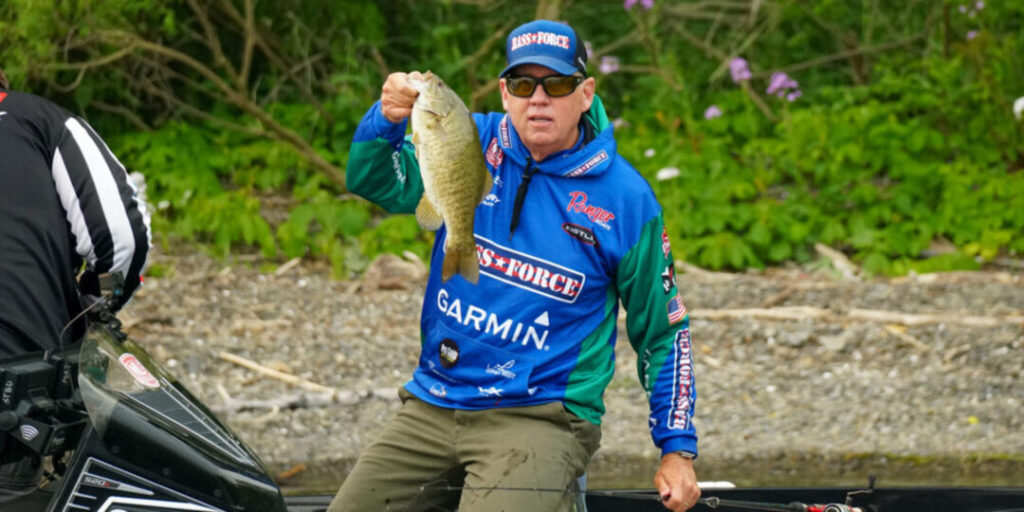
Alton Jones’ final event at Lake Erie is not just a retirement note tucked beside the Stage 7 leaderboard. It is a legacy story about how long a pro can keep adjusting as the sport changes around him, and what it means to leave the top level still thinking like a competitor.
That is why this moment belongs near the sport’s larger Hall of Fame history. Tournament bass fishing is built on wins, but it is also built on longevity, family, reinvention, and the rare anglers who become markers for multiple eras.
Alton Jones Final Event Carries More Than Sentiment
Jones wrote before Stage 7 that he had decided before the 2026 season that this would be his last year as a touring pro. Lake Erie would be his final tour-level event.
That announcement matters because Jones is not leaving as a forgotten name. His career stretches across 36 years as a professional angler, with a résumé that includes a 2008 Bassmaster Classic victory and decades spent competing through changing formats, technologies, sponsors, and expectations.
His final-event column did not read like a man trying to manufacture drama. It read like someone who still wanted to compete while recognizing the sport now demands a pace that feels different from the one he grew up mastering.
That is competitive honesty.
Lake Erie Is A Fitting Last Test
Lake Erie makes the ending sharper because it is not gentle water. Jones described the physical challenge clearly: chasing northern smallmouth can require long runs, big waves, and a level of efficiency that becomes harder to sustain across practice and competition.
That is what makes this setting meaningful.
A farewell on an easy lake might lean too heavily on ceremony. A farewell on Erie forces the same questions that have defined modern bass fishing: smallmouth or largemouth, risk or safety, weather window or backup plan, electronics or instinct, one more hard run or a smarter closer option.
Jones said he would let weather help dictate whether he chased smallmouth or stayed closer to Sandusky for largemouth. That is not surrender. That is an old pro reading the day.
Legacy Is Measured By More Than Trophies
Jones’ trophy case matters, but his career cannot be reduced to a list of wins. The angler profile notes more than 60 career Top 10s and places him among the few to reach the $3 million club in career winnings.
Still, a long career becomes important because of what survives after the numbers stop updating.
| Legacy Layer | What It Shows | Why It Lasts |
|---|---|---|
| Classic victory | Peak achievement | Defines a career ceiling |
| Long tour career | Adaptability | Shows staying power |
| Family connection | Fishing alongside Alton Jones Jr. | Extends the story across generations |
| Format transition | Competing through B.A.S.S. and MLF eras | Reflects sport-wide change |
| Public reflection | Leaving with gratitude | Gives the exit dignity |
That is why this is not only a retirement piece. It is a transition piece.
Fishing Alongside His Son Changed The Ending
One of the strongest parts of Jones’ late career is that he shared tour-level water with Alton Jones Jr. That is not common in professional sports, and it gives his exit a texture beyond statistics.
Father-son fishing stories can be easy to sentimentalize. This one has competitive weight.
Jones Jr. has built his own identity on tour, while Jones Sr. has remained more than a ceremonial presence. For a sport that often passes knowledge through families, boat ramps, small clubs, and long drives, their overlap at the highest level matters.
It gives the ending a bridge.
The older generation does not vanish. It hands off lessons, habits, and pressure-tested judgment while the next generation fishes faster, processes more data, and faces a very different tournament environment.
That is generational continuity on a public stage.
The Sport Changed While Jones Kept Competing
Jones’ career ran through one of the biggest transformations bass fishing has ever seen. Electronics changed. Coverage changed. Scoring formats changed. Sponsor demands changed. Young anglers entered the sport with tools and information that earlier pros could not imagine.
The modern Bass Pro Tour’s every-fish-counts format also adds a pace that can punish slow starts. Jones acknowledged that the margin between success and failure has become thin, especially against younger anglers who can keep pressure on all day.
That makes his career even more impressive.
Longevity in this sport is not only about still knowing how to catch bass. It is about staying curious enough to survive new rules, new lakes, new technology, and new competitors who grew up studying the generation before them.
Lake Erie Should Not Be The Last Word
The danger with any final event is treating it like a closed door. Jones made clear that he still plans to fish, stay active, and shift more of his public presence toward fun fishing and instruction rather than full-time tour pressure.
That may end up serving ordinary anglers well.
Some pros are most valuable when they stop chasing every cut line and start explaining what they have learned. Jones’ next chapter could give anglers a clearer look at decision-making, seasonal movement, lure discipline, fish care, and the mental side of staying with fishing for a lifetime.
The broader Bass Fishing Hall of Fame conversation is often about the past, but legacy is most useful when it teaches forward.
Alton Jones’ final event at Lake Erie deserves attention because it marks the end of a tour-level run, not the end of influence. The sport will keep getting faster and more technological, but careers like his remind anglers that judgment, humility, family, and time on the water still have a way of outlasting every new era.