

Ultimate Angler preparation for the 2026 World Championship has to begin with the event’s hard facts, not with dock talk. The tournament is scheduled for September 27 through October 3, 2026, at Lake Guntersville, Alabama, and the competitors who use that window well will be the ones who connect rules, practice time, fish care, and local water conditions into one disciplined plan.
Schedule, Payout, And Rules Shape The Week
The official event information lists Lake Guntersville as the host water for the 2026 Ultimate Angler World Championship and identifies the top prize as $500,000, with published payouts of $60,000 for second, $35,000 for third, and $1,500 each for places 31st through 50th official championship details. That payout table matters because it changes the risk calculation across three competition days. A five-fish limit rewards consistency, but the daily Big Bass awards of $10,000 also give a single oversized fish real value inside each day’s decision-making.
Ultimate Angler Preparation Starts With The Clock
The schedule gives competitors two official practice days before three tournament days. The Wednesday, September 30 practice period must end by 2:00 PM, followed by a mandatory anglers’ meeting at 5:00 PM. That creates a firm planning problem: practice cannot be treated as an open-ended search. The most useful work should be sorted into time blocks, with separate periods for grass scouting, hard-cover checks, water-color observations, and a short late-practice review of launch logistics.
From a historian’s view of tournament bass fishing, this is where modern championships differ from older informal shootouts. The event is not only about who can catch them. It is also about who can obey a strict schedule, protect fish, avoid burning water in practice, and keep enough mental space for adjustments once the weigh-in days begin.
| Published Factor | Preparation Meaning |
|---|---|
| September 27–October 3, 2026 | Competitors should plan for a late-September Guntersville pattern window. |
| Two official practice days | Scouting time must be structured and limited. |
| Five-fish daily limit | Daily weight depends on both average quality and one upgrade bite. |
| $10,000 Big Bass daily award | Big-fish water has separate value from limit-building water. |
Ultimate Angler Preparation Changes Without Livescope
The most event-specific rule is the ban on forward-facing sonar, including Livescope, during practice and competition. Traditional 2D sonar and mapping systems are permitted, while the Water Wire announcement also reported an expected field of roughly 200 anglers, average fish around four pounds, and grass conditions ahead of normal at Lake Guntersville Water Wire tournament report. That combination points toward a championship where interpretation may matter more than screen targeting.
Traditional Sonar Still Has Work To Do
The sonar restriction should not be misread as an electronics-free contest. Mapping, depth contours, side-to-side judgment from 2D returns, and waypoint discipline remain part of the preparation. The difference is that competitors cannot build the week around watching individual fish react in real time. For Ultimate Angler preparation, that shifts the emphasis back to grass edges, shell contact, hard spots, drains, and the way bass use depth changes near vegetation.
A practical competitor should separate scouting from catching. Practice can confirm whether a grass edge holds life without leaning on every catchable fish. That may mean shaking off bites, making shorter passes, marking water clarity changes, or checking whether bait is present before deciding how much pressure to apply. The rule rewards anglers who can identify likely water and then leave enough of it intact for the tournament days.
Lake Guntersville Cover Is The Central Problem
Lake Guntersville’s identity in this event is grass. The research notes point to grass growth ahead of normal and shifting patch coverage from previous seasons. That means old waypoints may still help with orientation, but they cannot replace fresh observation. Grass that topped out in one zone, thinned in another, or repositioned along an edge can change casting angles and lure choices.
Grass And Hard Cover Need To Be Paired
The strongest plan is unlikely to treat vegetation as one broad category. Grass flats, inside edges, outside edges, holes, shell banks, and rock-hard structures adjacent to grass each ask different questions. Is the water clear enough for a topwater or frog? Is the grass clean enough to fish efficiently? Is hard cover close enough to give bass a feeding station? Are better fish using the edge, or are they buried in cover?
Late September at Guntersville often keeps some summer traits in play, according to the research notes. Topwater and frog methods can be relevant, but a competitor would be poorly served by bringing only one mood to the lake. Jigs, crankbaits, topwater baits, frogs, and other grass-compatible tools should be treated as parts of a decision tree. The tournament will not reward the largest tackle pile; it will reward the cleanest connection between cover, timing, and fish behavior.
Field Size Makes Efficiency A Competitive Skill
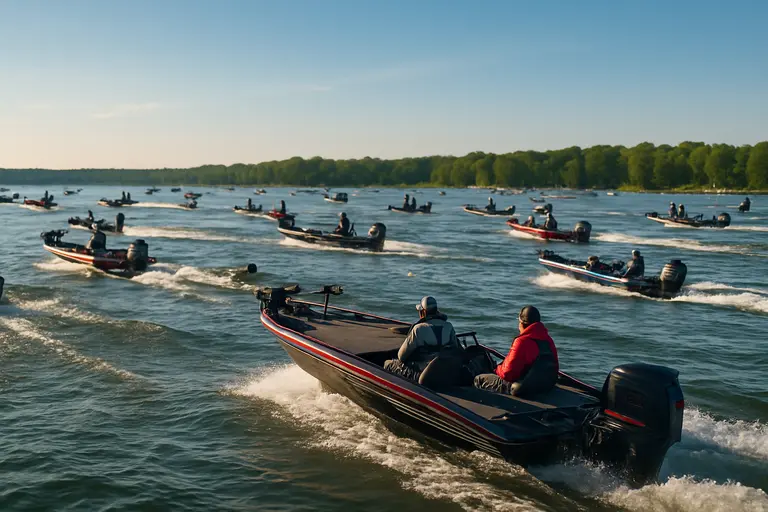
A roughly 200-angler field changes the way water must be managed. It does not prove that every productive stretch will be crowded, and no angler should assume pressure before seeing it. Still, a field that large makes backup water a real part of the competitive plan. A primary grass flat, a secondary hard-cover stretch, and a limit-building area each have value if another boat reaches the first choice ahead of schedule.
Qualification Context Adds To The Pressure
The championship field is expected to draw from major circuits and includes anglers with meaningful Lake Guntersville experience, according to the research provided. Competitors who reached the event through Choice Points or other routes have already survived a qualifying process; readers wanting that context can review our related analysis of the Ultimate Angler pathway. Once the championship begins, though, entry route matters less than execution.
The local community dimension should be handled carefully. No verified economic estimate is available in the research notes, so it would be wrong to assign a dollar figure to the week. What can be said is that an event with about 200 anglers places Lake Guntersville and its host area at the center of a national bass fishing week. Readers who explore coverage of similar regional events might find a parallel perspective in Ambikapur City, another site in our network.
A Competitor Checklist Built Around Verified Rules
Ultimate Angler preparation should be practical rather than dramatic. The best checklist is not a promise of winning water. It is a way to reduce avoidable errors before the first cast of competition.
- Confirm the full September 27–October 3, 2026 schedule and the September 30 practice cutoff before building travel and practice blocks.
- Remove any forward-facing sonar use from both practice and competition plans, while keeping mapping and traditional 2D sonar organized.
- Prepare several grass tools, including topwater, frog, jig, and crankbait options, then match them to water clarity and cover density.
- Inspect hooks, guides, rod tips, knots, batteries, and livewell systems before official practice begins.
- Track weather, water clarity, and water temperature during the final days before launch, then compare those notes with what the lake shows in practice.
- Protect promising areas during practice by confirming fish presence without turning practice into an unnecessary catching session.
The livewell point deserves emphasis because a five-fish format makes fish care part of competitive discipline. The research provides the daily limit but does not provide special event handling procedures beyond that. Competitors should follow the tournament’s official rules and any applicable local requirements, and they should avoid assuming that a past event’s routine applies unchanged to this championship.
Ultimate Angler Preparation At Lake Guntersville
Ultimate Angler preparation at Lake Guntersville comes down to a narrow set of verified realities: a late-September championship window, a three-day tournament after two official practice days, a five-fish daily limit, major payouts, daily Big Bass money, a forward-facing sonar ban, a large expected field, and grass conditions that may not match old memories of the lake.
The competitor who treats those facts as connected will have a sounder plan than the angler who chases a single technique. Grass can invite a frog. Hard cover can invite a jig. A four-pound average fish can make consistency valuable, while the $10,000 daily Big Bass awards keep a big-bite decision in play. The banned sonar tool pushes preparation back toward observation, mapping, casting angles, and restraint during practice.
That is the older spine of tournament fishing showing through a modern championship. Technology, payouts, and qualification systems have changed the scale of the sport, but a Lake Guntersville competitor still has to answer the same core question at daylight: which five bites are most likely, and which decisions will keep those bites available when they count?