

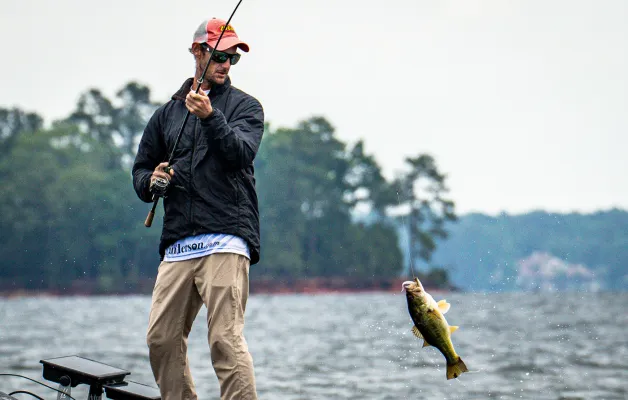
Paul Marks Lake Murray was not just a trophy story; it was a sharp reminder that modern tournament bass fishing rewards speed, nerve, and the ability to abandon a fading plan. Marks won the 2026 Tedy’s Team Bassmaster Elite at Lake Murray with 90 pounds, 14 ounces and made the result feel bigger by closing with a final-day adjustment after his early herring program stopped giving him what he needed. That is why this win matters: it showed how quickly a herring lake can punish certainty and reward instinct.
Why Paul Marks Lake Murray Became The Bass Fishing Story
The official Paul Marks Lake Murray result has the obvious ingredients of a strong tournament recap: a four-day winning total, a second Elite Series title, a $101,000 payday, and a Championship Sunday bag of 25 pounds, 2 ounces. Those details are valuable, but the deeper story is how the tournament was won, because they reveal pace and stakes.
Marks did not simply ride one obvious pattern from launch to trophy. His early herring-related areas failed to produce the day he needed, which forced a decision. He could keep chasing what had made sense earlier in the week, or he could trust what the lake was telling him in real time. He chose the second path, leaned into riprap, and turned a difficult start into the heaviest bag of the final day through decision and trust.
That move separates a good finish from a defining win. On herring lakes, bass can behave like ghosts. They roam, suspend, chase bait, disappear, reload, and punish anyone who mistakes yesterday’s success for today’s answer. Marks handled that volatility and pressure better than the field when it mattered most.
The win sharpened his identity, too. Both of his Elite Series victories have now come on blueback herring lakes, with Lake Hartwell in 2025 and Lake Murray in 2026. That does not make him unbeatable on this style of water, but it gives the story shape. He is becoming a reference point for how this pattern should be managed under pressure.
The Final-Day Adjustment Was The Whole Article
The most revealing part of the win was not the total weight. It was the pivot.
Tournament fishing often gets simplified into bait choice, location, or weather. Those things matter, but the best anglers are not just collecting conditions. They are interpreting the lake while the clock is running. When Marks realized his starting places were not producing, he had to decide whether the problem was timing, pressure, fish movement, or the entire plan. That required judgment and discipline.
Riprap gave him a different lane. It offered a way to fish where bass could relate to hard cover, bait movement, shade, current influence, or subtle positioning changes. More importantly, it gave him a way to stop waiting on a dead script. That is where the win gained its real authority and weight.
There is always risk in leaving fish, especially on the final day of an Elite event. Anglers can talk themselves into patience because patience sometimes wins. But patience can become stubbornness. Stubbornness can become panic. The hardest move is knowing when patience has turned into denial.
Marks made the move before the day got away. That is why the 25-2 final bag matters. It was not just a big number. It was the result of timing, trust, and a willingness to accept that the lake had changed.
What A Herring Lake Actually Demands
Blueback herring change bass behavior because they create a faster, more open-water feeding environment. Bass that chase herring are often less tied to the traditional cover patterns many anglers grew up trusting. They can suspend over points, humps, cane, brush, docks, shoals, and open water. They can look obvious for five minutes and impossible for the next hour because movement and speed define the bite.
That is why herring lakes create so much tension. They are not random, but they can feel random to anyone who is a step behind the bait. The angler is rarely just fishing a spot. He is fishing movement, timing, feeding windows, sun angle, wind, and pressure from other boats.
Lake Murray showed that clearly. The event rewarded anglers who understood that bass relating to herring may not behave with traditional consistency. A place can look perfect and be empty. Another can seem ordinary and suddenly fire. The difference may be the bait, the angle, the cast, or the moment.
That makes the pattern dangerous in the best possible way. It creates huge opportunity, but it also creates risk. If the herring move, the bass move. If the bass move, the winning pattern may not be a pattern at all. It may be a series of decisions connected by instinct and repetition.
Lake Murray Turned Experience Into A Weapon
Marks’ background made the win feel logical. A Georgia angler with deep experience around herring-style fisheries has a comfort level that cannot be manufactured in one practice period. That experience does not guarantee the right decision, but it gives an angler more references when the day gets confusing.
That is the hidden value of time on similar water. A herring lake teaches an angler to read absence as well as presence. If the fish do not show up, that is information. If they show but do not commit, that is information. If bait is present but the bass are not positioned correctly, that also matters.
For serious bass fishing readers, the better storyline is how Marks processed the lake. He did not need a perfect morning. He needed enough clarity to recognize that the winning path was somewhere else.
That ability is becoming more important across tournament fishing. Technology, pressure, and information have tightened the field. More anglers can find fish. More anglers understand seasonal movement. More anglers can survive with forward-facing sonar, mapping, and refined presentations. The separator becomes decision quality under stress.
The Win Fits A Larger Shift In Bass Fishing
Professional bass fishing is moving deeper into an era where adaptability is not optional. The old image of an angler camping on a single magical spot still exists in certain events, but herring lakes are often less forgiving. They demand adaptability, observation, and comfort with incomplete information.
That creates a modern strategy challenge. Anglers must decide when to trust electronics, when to fish memories, when to follow bait, when to return to a place that was empty earlier, and when to abandon a pattern that should be working but is not. None of those decisions can be solved by one bait or one waypoint.
This is why herring-lake wins can feel so educational. They reveal how much of elite fishing happens before the hookset. The cast matters, of course. So does landing the fish. But the decisive moments often come earlier, when the angler chooses the next bank, point, dock, or stretch of riprap with choice and precision.
Marks’ Lake Murray win belongs in that conversation because the final-day adjustment was central. It showed that the best tournament anglers are not merely executing a plan. They are editing it in real time through change and awareness.
How The Tournament Arc Built The Drama
| Tournament Element | Why It Mattered |
|---|---|
| Four-day total: 90-14 | Established a winning pace that required consistent quality |
| Final-day bag: 25-2 | Turned the closing round into the defining performance |
| Early herring areas faded | Forced a major decision instead of a comfortable finish |
| Riprap adjustment | Created the path to the heaviest Sunday bag |
| Second Elite title | Strengthened Marks’ status on herring-style fisheries |
| Lake Murray setting | Reinforced how volatile bait-driven lakes can become |
This table clarifies the real shape of the story. It was not a one-fish miracle. It was a tournament arc built on adaptation. The week demanded consistency, then enough nerve to make the right call on the final day.
For a useful contrast, the recent Lake Havasu Open recap showed a different version of tournament pressure, where a big-bite storyline and final leaderboard compression shaped the drama. Lake Murray tells another story: bait movement, herring behavior, and the need to pivot before a winning day slips away.
The Difference Between A Pattern And A Decision Tree
The word “pattern” can be misleading. It makes fishing sound more fixed than it really is. A pattern is useful only if the fish keep validating it. Once they stop, the angler needs a decision tree built on context and feedback.
That distinction explains why Marks’ win feels so relevant. His early herring areas were part of the week’s logic, but they did not provide the final answer. The riprap move was not a random guess. It was a decision inside a larger framework, and that framework showed real execution.
A decision tree asks better questions. Are the fish still chasing? Are they relating to hard cover? Has the sun changed their positioning? Did boat pressure alter the bite? Has bait moved? Is the lake asking for speed, patience, or a new angle?
Those are not beginner questions. They are the questions that define elite focus. The best anglers rarely fish without a reason, even when the move looks bold from the outside.
What Everyday Anglers Can Learn From Marks’ Win
The lesson for everyday bass anglers is not to copy every detail from an Elite event. Most anglers are not managing the same field pressure, media attention, or fishery knowledge. Still, the logic travels well.
First, do not let yesterday’s success become today’s trap. A productive area can die. A bait-driven bite can move. A fishery can feel completely different after a change in sun, wind, pressure, or boat traffic. The right response is honest evaluation, not automatic change.
Second, build your day around feedback. Bait position, missed bites, short strikes, empty targets, and changes in activity all mean something. The best anglers are not emotionally attached to being right. They are attached to finding the next right move with humility and intent.
Third, respect hard cover when open-water behavior becomes unstable. Riprap, docks, brush, cane, and other defined targets can become important when bass need a place to position. That does not mean every herring-lake fish suddenly becomes a shoreline fish. It means structure can provide a more readable path when roaming fish stop cooperating.
Finally, understand that confidence is not the same as rigidity. The angler who changes too often never builds momentum. The angler who refuses to change loses the day. Marks’ win sits in the middle, where confidence and flexibility meet.
Why Marks’ Herring-Lake Identity Matters
The idea of Marks as a herring-lake specialist is compelling because it gives fans a framework. Every sport needs identities. Some athletes are closers. Some are tacticians. Some are power players. In bass fishing, identities are often built around regions, techniques, fishery types, and pressure moments.
Marks now has a claim to one of the most interesting modern identities: the angler who understands herring lakes when they get unstable. That identity may evolve, and it should not be overstated too early. But it is real enough to matter after two Elite wins on this style of water.
It also creates future interest. When the Elite Series returns to a lake shaped by blueback herring, Marks will draw attention immediately. Fans will watch his decisions differently. Competitors will understand that he has confidence in that environment. Media coverage will have a storyline before the first cast.
That is how reputations form in tournament fishing. Not through one win alone, but through repeated evidence in similar conditions. Lake Murray added another strong piece of evidence.
The Trade-Offs Of Chasing Herring Fish
The herring bite can make an angler look brilliant or lost. That is its beauty and its threat.
When it works, the fish can be big, aggressive, and grouped around the kind of bait movement that creates fast limits and big upgrades. When it fails, it can leave an angler chasing empty water and trying to interpret silence. The same style that creates explosive upside also brings real cost.
That trade-off defines herring-lake tournaments. Do you chase the high ceiling or look for something more stable? Do you keep running places or commit to a stretch? Do you trust bait movement or visible cover? Do you fish fast enough to intercept activity or slow enough to convert difficult fish?
Marks answered those questions better than anyone at Lake Murray. His win did not erase the risk of the herring program. It showed how to survive it. He understood when the original lane was no longer enough, then found a better way to keep quality bites coming.
That is why this story should resonate beyond one lake. It is really about managing uncertainty. Every angler faces that, whether on a famous herring reservoir or a small local lake with weekend pressure and changing weather.
What Readers Should Watch Next
The next question is whether Marks’ Lake Murray win becomes a template or a warning. Other anglers will study the result, but copying the visible pieces may miss the point. The riprap mattered because it fit the moment. The herring background mattered because it shaped his understanding. The final-day bag mattered because he converted the decision.
Tournament bass fishing is becoming more demanding in how quickly anglers must process change. Herring lakes amplify that reality, but they do not own it. Across the sport, the winning edge often comes from recognizing that a plan has shifted before the leaderboard proves it.
That creates an opportunity for better coverage. Fans deserve more than names and weights. They deserve explanations of why a bite changed, how an angler responded, and what the result says about the direction of the sport. The Lake Murray Elite Series calendar will keep producing results, but the best stories will come from the adjustments behind those results.
Paul Marks Lake Murray should be remembered as more than another blue trophy. It was a herring-lake statement, a final-day pivot, and a reminder that modern bass fishing increasingly rewards anglers who can turn uncertainty into momentum. The win matters now because it gives the sport a clear lesson: when bait moves, pressure builds, and the obvious plan fades, the best anglers do not wait for the lake to become familiar again. They make the next right decision before everyone else does.