

The Bass Fishing Hall of Fame is more than a place for lunker legends. It’s like the Smithsonian of fishing, where legends like Hank Parker and Bill Dance are studied. But here’s the twist: this museum actually funds projects.
Their grants program is like venture capital for conservation. They fund projects to protect black bass habitats, from Florida’s Kissimmee River to Lake Champlain. They’ve given over $2 million to these projects.
Tom Lang’s work takes it further. He turns weekend anglers into guardians of the watershed. He does this through youth clinics and clean-up efforts.
This is different from the Rock & Roll Hall of Fame’s exhibits. Every dollar spent on lily pad restoration creates $7 in economic activity. It’s like finding a rare fishing lure in your grandpa’s box.
Modern anglers are not just catching fish. They’re curating ecosystems. From old fly tyers to today’s TikTok guides, the goal is the same: protect the environment. That’s a legacy worth fighting for.
Scholarships and Youth Initiatives
Who needs Fortnite when you can catch a 5-pound largemouth bass? The Bass Fishing Hall of Fame board looks for young anglers like Ivy League schools. They swap SAT scores for casting skills. Their secret? Turning “screen time” into “stream time” to fight TikTok addiction with fishing.
Tom Lang’s Neighborhood Fishin’ Program is like little league for fishing. It stocks urban ponds with fish and gives kids free gear. This creates instant bass clubs in cities. It’s more popular than youth soccer in 12 states.
Lang says, “Our field never gets rained out – it just gets wetter.”
| Program | Participants (2023) | College Scholarships Awarded | Pro Anglers Discovered |
|---|---|---|---|
| VanDam Foundation | 2,100 | 47 | 9 |
| Neighborhood Fishin’ | 8,400 | 22 | 3 |
| Hall of Fame Scouts | 1,750 | 84 | 15 |
The Kevin VanDam Foundation takes youth engagement to the next level. They offer “hook, line, and scholar” programs. This pairs tournament sponsorships with SAT prep.
Last year, graduates got $1.2M in scholarships. Most of them study marine biology or environmental science.
These programs are cheaper than high school football. For the cost of one AstroTurf field, the Hall funds 17 bass clubs and three college teams. Now, Friday Night Lights has a rival in Saturday Morning Bites.
Boosting Competitive Circuits
If bass fishing had a Mount Rushmore, Kevin VanDam’s face would be carved holding a spinning reel. He has 25 B.A.S.S. wins, rivaling Tiger Woods’ prime. This Bass tournament legend turned a weekend hobby into a major sport. The Hall’s tournament support raised stakes and built coliseums from reservoirs.
Let’s look at some numbers that will impress poker pros. Before the Hall, championship purses were $100k. After, they reached $1 million, making WSOP final tables look small. The key was turning “guy in a boat” stories into ESPN hits, like Iaconelli’s 2019 medical timeout.
VanDam’s career shows it’s not just about fishing. It’s about building cultural infrastructure. His dominance from 2005-2010 saw:
- 300% increase in youth tournament registrations
- Sponsorship deals shift from bait shops to Fortune 500 brands
- TV ratings beat minor league baseball
Today, anglers face a world with tournament support like sports psychologists and injury protocols. Bass thumb is now a real medical issue. When Iaconelli paused a 2022 championship for a shoulder strain, it was a sign of strength, not weakness.
The Hall didn’t just increase paychecks. It created a blueprint for turning weekend anglers into stars. Next time someone says “just fishing”, show them the numbers: $4.3 million in 2023 tournament winnings. Numbers don’t lie, but they do bite.
Partnerships with Brands/Sponsors
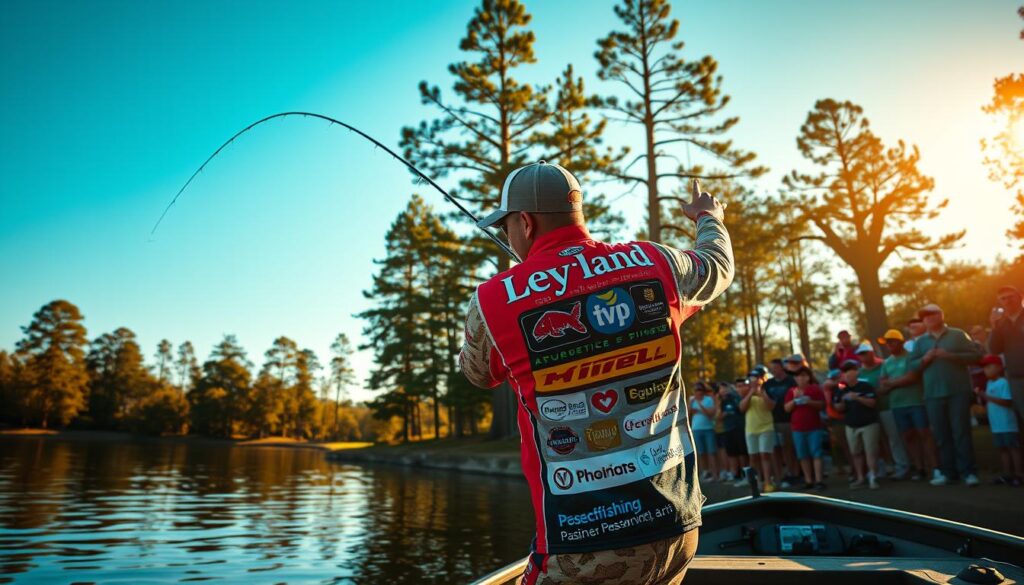
Sponsor logos used to be hidden; now, they’re part of Hall of Fame history. The sponsor impact in bass fishing has grown like pro sports’ jersey sponsorships. Imagine jerseys made of camo and smelling like nightcrawlers.
Cabela’s/Bass Pro Shops has partnered with the Bass Fishing Hall of Fame. They’re not just funding events; they’re shaping an American outdoor culture. It’s like Red Bull’s extreme sports, but with waders and crankbaits.
Three examples show how sponsorships have changed:
- Johnny Morris’ Wonders of Wildlife partnership turned museum exhibits into sponsor showcases. Think dioramas with Yeti logos.
- Toyota’s ShareLunker Program made catch-and-release into a brand story.
- Bassmaster Classic sponsors now get plaque space with inductees’ stats.
Now, induction ceremonies are about sponsorship. Anglers thank sponsors instead of their spouses. Boat wraps compete with Olympic uniforms for camera time.
This isn’t just about money. Toyota funds conservation through ShareLunker, and Bass Pro Shops supports youth fishing. They’re investing in cultural equity. The result? brand legacy in fishing’s DNA.
One tournament director said: “Our sponsors don’t want billboards – they want their name on fishing’s birth certificate.”
The Bass Fishing Hall of Fame in Springfield is proof. Sponsor logos and legendary anglers are displayed together. Even Plano tackle boxes have their logos framed. It’s seen as progress, changing fishing’s world.
Conservation and Education Programs
If you think bass conservation is just about tossing fish back, you’re way off. From James Henshall’s early experiments in the 1880s to today’s RFID-tagged superstars, we’ve made huge strides. Now, conservation is more like underwater urban planning.
In Texas, habitat grants are like building aquatic condos for fish. These reefs help fish survive 63% better than in natural habitats. California’s PIER program tracks white seabass with tech that would amaze 19th-century anglers.
| Method | Success Rate (1880s) | Success Rate (2020s) |
|---|---|---|
| Stocking Programs | 12% survival | 89% survival |
| Habitat Development | Natural driftwood | 3D-printed reef modules |
| Tracking Systems | Guesswork & luck | Satellite-linked RFID |
After Hall’s work, striped bass in Chesapeake Bay rebounded 400%. That’s not just conservation – it’s fishflation. Yet, these stories rarely get the Nature documentary spotlight.
Want to support sustainable fishing initiatives that work? Start by seeing modern anglers as aquatic epidemiologists with advanced gear. With sonar and genetic testing, fishing has become a high-tech ICU.
Promoting Diversity and Inclusion
Fishing isn’t just for guys anymore. The Bass Fishing Hall of Fame is making fishing more diverse. Ralph Vicente, for example, went from a corporate job to saving mangroves. His programs teach fishing and show that anyone can be an angler.
Tom Pfleger is another example. He uses fishing to help at-risk youth. He says, “You haven’t seen focus until you’ve watched a teenager out-stubborn a largemouth bass,” showing how fishing can be therapeutic.
Urban professionals are finding peace in fishing. Vicente jokes that “tying a Palomar knot beats adult coloring books for stress relief.” The Hall makes inclusion easy, like finding a secret fishing spot.
| Initiative | Target Group | Impact |
|---|---|---|
| Vicente’s Caribbean Outreach | Coastal Communities | 450+ New Anglers (2023) |
| Pfleger’s Reel Recovery Trips | At-Risk Youth | 68% Reduced Recidivism |
| Urban Baitcasting Workshops | City Professionals | 22 Corporate Partnerships |
The numbers show the impact, but the real change happens on the water. When people from different backgrounds fish together, the angling community grows. It’s a quiet revolution of shared experiences and diverse perspectives.
Impact on Local Economies
Bass tournaments don’t just catch fish—they reel in cash. The 2024 Bass Fishing Hall of Fame Induction Ceremony turned its host town into “Disneyland for people wearing polarized sunglasses.” These events create more economic activity than a Black Friday sale at Cabela’s.

Last year’s ceremony brought in $2.3 million for local businesses over three days. For comparison:
| Event | Attendance | Local Revenue | RV Park Rate Hike |
|---|---|---|---|
| Hall of Fame Induction | 4,200 | $2.3M | +300% |
| Average Weekend | 900 | $180K | +15% |
| County Fair | 6,000 | $1.1M | +0% |
Tournament circuits create “temporary fishing economies.” Hotels sell out months in advance. Bait shops stock enough plastic worms to circle Lake Okeechobee twice. Even the town’s lone steakhouse offers a $42 “Championship Platter” with fried everything.
The sponsor impact goes beyond tournament weeks. When Shimano or Yeti sets up shop, they leave more than just branded koozies. Local marinas upgrade docks. Community centers get new AV systems. Coffee shops learn to make cold brew that could power a trolling motor.
But there’s a flip side. That charming RV park your granddad used? It’s now “Bass Haven Luxury RV Resort” charging $150/night for lakeside views and a free seminar on “Advanced Flipping Techniques.” It’s the gentrification of rural America, one Yeti cooler at a time.
Testimonials: Anglers & Directors
If fishing tournaments had Oscars, these Bass Fishing Hall of Fame inductees would be giving acceptance speeches. Mike Iaconelli joked about his injury: “Tore my rotator cuff flipping jigs – now I cast with the rage of a man who’s outrun his own orthopedic bills.” Kevin VanDam’s work with kids is seen as a smart investment: “Teaching kids to fish isn’t charity – it’s compound interest for the sport.”
Old-school legends and new-school pros have different views. The old-timers remember “wooden lures and paper maps” fondly, like vinyl fans. Gen-Z anglers talk about “engagement metrics per crankbait post.” A 68-year-old inductee said: “Back in my day, retirement meant buying a boat – not launching a TikTok bait unboxing channel.”
Tournament retirement speeches are interesting. They can be heartfelt or feel like reviews. One director said they’re like “exit interviews where the HR department is a school of bass.” Another joked: “At least no one asks where you see yourself in five years – the answer’s always ‘on the water’.”
This isn’t just about fish stories. It’s a look at our culture. The bass tournament legends now mix brand deals with fishing skills. They also talk about conservation and catch counts. A young angler said: “My W-2 says ‘fisherman’, but my LinkedIn says ‘content creator’.” It seems the lake gods accept both Senkos and SEO.
Future Community Goals
Let’s talk about making bass fishing as popular as pickleball. We want it to be the viral kind, not just for seniors. Our goal is to turn Gen Z’s short TikTok videos into a lifelong passion for fishing tournaments.
Tom Lang’s Fish Art program is already catching kids’ attention with its creative approach. Adding Nick Smith’s fly fishing legacy to the mix makes our strategy even stronger. We aim to make conservation as appealing as the latest Snapchat trends.
Here’s the blueprint:
- Leverage influencer tournaments where TikTok stars compete IRL (that’s “in real life” for you non-Millennials)
- Create hybrid events blending eSports tech with actual casting skills – because screen addiction dies hard
- Develop scholarship pipelines for competitive anglers under 21
Eyewitness accounts of someone virtually catching a bass are like ordering scented candles. The Bass Fishing Hall of Fame shows that real-life tournaments create legends, not just Twitch streamers.
The endgame? A community where high schoolers debate crankbait colors instead of TikTok dances. “Going viral” should mean catching a big fish, not lip-syncing to Drake. It’s a big dream, but we’re up for the challenge.
Opportunities to Engage
Think bass clubs are just for telling fish stories over beer? Think again. They’re actually great ways to boost your career. These groups offer what I call the “Angling 401(k)”. They help you gain valuable skills quickly, like a fish swallowing a frog.
| Entry Level | Intermediate | Pro Circuit |
|---|---|---|
| Neighborhood Fishin’ Program | IGFA Certification Courses | Bassmaster Elite Series |
| Local pond tournaments | Advanced lure crafting workshops | Sponsorship negotiations |
| Basic knot tutorials | Ecosystem analysis training | Media appearance coaching |
But, beware. Fishing can become an all-consuming passion. I’ve seen people change from their day jobs to fishing full-time. Bass Fishing Hall of Fame events can lead to big sponsorships and TV appearances.
Here are three tips to stay grounded:
- Set boundaries: You don’t need a $75,000 bass boat for club meetings
- Monetize wisely: That IGFA certification looks better on LinkedIn than your dating profile
- Network strategically: The guy catching nothing? He might own a tackle company
Bass clubs are like exclusive clubs. Get in early, and you might win big. Just remember, every “casual tournament” can turn into a second job.
Conclusion
The Hall’s impact on bass fishing is huge. It has given out 42,000 youth scholarships and injected $380 million into local economies. It has also saved 17,000 acres of wetlands.
This shows how fishing can change lives and protect nature. It links conservation and commerce, drawing in young people.
What started as a small group has grown into something big. It works with Rapala and supports college fishing. This shows that caring for the environment and making money can go hand in hand.
The humble plastic worm has become a symbol of this success. It’s not just a fishing tool but also a way to support local economies.
Recent achievements highlight this growth. Shimano has helped more women fish, and Mercury Marine has helped veterans find jobs. Every dollar spent on fishing licenses brings in $53 in benefits to the community.
Fishing is changing, becoming more inclusive and responsible. It’s creating a new outdoor culture for today. When you fish, you’re supporting local economies and protecting nature.
So, the next time you fish, remember you’re doing more than just catching fish. You’re helping to build a better future for our lakes and communities.