

Wyatt Burkhalter’s Grand Lake victory arrived at exactly the kind of moment tournament bass fishing needed: technical, tense, and revealing. In an era increasingly shaped by electronics, mapping, and hyper-specialized patterns, the Wyatt Burkhalter Grand Lake win became a reminder that competitive fishing still turns on judgment, adaptation, and the courage to commit.
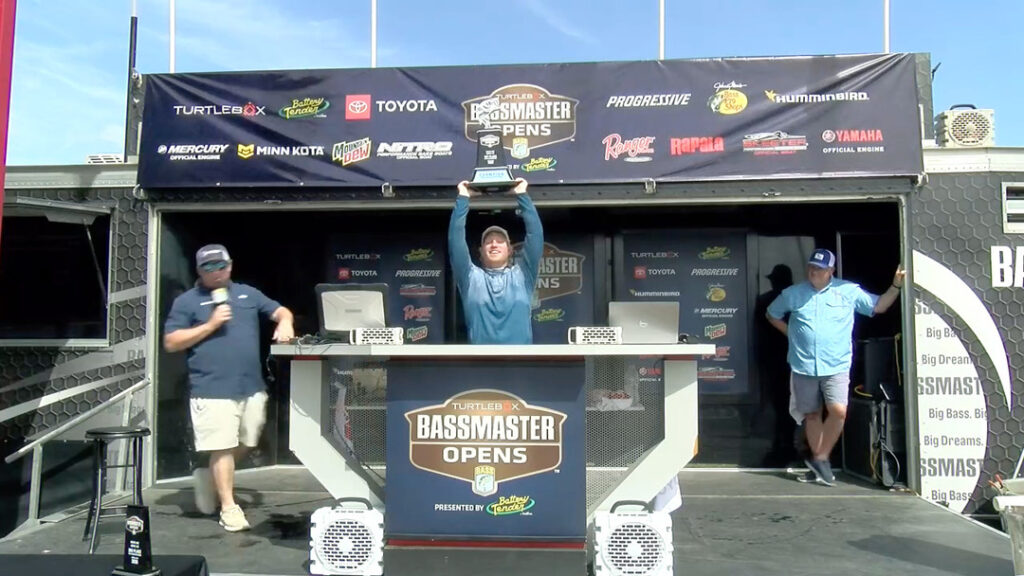
Burkhalter won the 2026 Turtlebox Bassmaster Open at Grand Lake O’ the Cherokees with 68 pounds, 11 ounces, closing the event on April 25 with a commanding margin. But the number alone does not explain why this win matters. What stood out was how he built it: from an unconvincing practice, through changing conditions, into a final-day performance rooted in one of bass fishing’s most enduring truthswhen the right fish are feeding in the right place, conviction beats clutter.
A Win Built From A Bad Practice
Every tournament angler understands the discomfort of a poor practice period. It compresses decision-making, magnifies doubt, and tempts competitors into chasing too many ideas at once. Burkhalter’s week at Grand Lake appeared to begin that way. The clues were limited. The certainty was thin. The lake did not simply hand him an obvious winning program.
That is precisely why the performance deserves attention.
The best tournament wins often look clean in hindsight, but they are rarely clean in real time. Burkhalter had to identify a pattern strong enough to carry three days, then trust it even as other anglers pressured similar water and weather conditions shifted around him. His progression from fourth place after Day 1 to a narrow Day 2 lead, and then to a decisive final margin, reflected more than catching power. It reflected tournament management.
The lesson is not that he found a magic lure or an untouched stretch of lake. The lesson is that he recognized the best available path and refused to dilute it. At Grand Lake, decisiveness became a competitive edge.
Why Grand Lake Was The Right Stage
Grand Lake O’ the Cherokees has long held a reputation as a tournament lake with both opportunity and volatility. Its rocky structure, main-lake points, stained-water personality, and seasonal bait movement can create the kind of event where anglers must fish fast but think carefully. It is rarely enough to simply cover water. The winner must understand why a stretch is reloading, why certain points produce better bites, and how timing intersects with the feeding window.
That context made Burkhalter’s win especially compelling. His key areas were tied to main-lake rocky points and a shad-spawn bite, a pattern that can be explosive but unforgiving. The shad spawn is often a morning-driven, timing-sensitive phenomenon. When it is right, bass can feed aggressively and predictably. When it fades, an angler can be left with empty-looking water and a shrinking clock.
Executing that pattern over multiple days requires restraint. It can be tempting to abandon it when the early bite feels inconsistent or when fish miss the bait. Burkhalter’s final day included exactly that tension: smaller fish connecting, better fish showing themselves but not always committing. Many anglers unravel in that gap between evidence and execution. Burkhalter did not.
The Spinnerbait Statement
The lure story matters because it cuts against one of the sport’s dominant narratives. Burkhalter’s winning approach centered on a spinnerbait, a classic power-fishing tool that remains devastating in the right hands. The broader message was not nostalgia. It was precision.
A spinnerbait is not merely an “old-school” bait. It is a tool of speed, vibration, flash, deflection, and water-column control. Around a shad spawn, those traits become highly relevant. The bait can imitate fleeing forage, trigger reaction bites, and move efficiently across rock, points, and wind-affected banks. In the right conditions, it allows an angler to keep the trolling motor down and force bass to reveal themselves.
That matters in a modern tournament landscape where some observers reduce fishing strategy to electronics versus tradition. The Grand Lake result was more sophisticated than that. Burkhalter’s win showed that a traditional lure, applied with exact timing and confidence, can still dominate a major field. It was not a rejection of technology as much as a reminder that technology does not replace pattern recognition.
Pressure, Restraint, And The Final Day
The final day of a tournament tests a different skill set than the opening round. Early in an event, anglers can fish to build. On Championship Saturday, they fish to close. That changes everything.
Burkhalter entered the last day with only a narrow lead, which created a dangerous strategic balance. Protecting a lead can make an angler conservative. Chasing more weight can make an angler reckless. The best closers do neither. They continue fishing the winning pattern while managing emotional tempo.
That appears to be the defining feature of the Wyatt Burkhalter Grand Lake win. He did not spin out when big fish missed. He did not scatter across the lake looking for backup plans that might have burned valuable time. He understood what his best option was and stayed aligned with it.
That kind of composure is easy to underestimate. Bass fishing looks quiet from the outside, but tournament pressure is mentally loud. Each lost fish can distort judgment. Each nearby competitor can create urgency. Each weather change can invite second-guessing. Burkhalter’s ability to stay with the program turned a strong tournament into a runaway finish.
What The Margin Really Means
Winning by 11 pounds, 10 ounces in a Bassmaster Open is not a minor separation. In a field filled with skilled anglers, that kind of margin usually points to a pattern that was not merely good, but better in quality, repeatability, and execution. It suggests that Burkhalter was not just catching enough bass; he was consistently around the right class of fish.
His three consecutive limits over 20 pounds underscore the same point. In tournament terms, one big bag can be momentum. Two can be confirmation. Three is dominance.
The margin also reframes the earlier uncertainty of his practice. What looked like a weak lead-in became a case study in reading a tournament as it unfolds. This is one of the core differences between recreational fishing success and high-level competition. A tournament angler is not only trying to catch bass; he is trying to identify the most durable winning decision under time pressure. Burkhalter’s week was a practical demonstration of that discipline.
The Forward-Facing Sonar Context
No discussion of a major bass tournament in 2026 is complete without acknowledging the electronics conversation. Forward-facing sonar has reshaped tactics, scouting, casting angles, and even the way fans interpret competitive fishing. Yet Grand Lake offered a different lens because this event was among the Opens division tournaments where forward-facing sonar was not permitted.
That rule environment made Burkhalter’s victory especially resonant. It placed greater emphasis on visual interpretation of conditions, historical knowledge, casting efficiency, bait selection, and physical pattern development. Rather than watching individual fish on a screen, anglers had to trust seasonal movement, structure, cover, and instinct.
This does not make the win more “pure,” a term that often oversimplifies the sport. It makes the win analytically useful. It shows how the competitive hierarchy can shift when rules change the available tools. Anglers with strong shallow-water instincts, bait-specific confidence, and pattern-development skills may gain ground in formats that limit advanced electronics. Burkhalter’s performance will likely be discussed in that context long after the trophy photo fades from the news cycle.
What It Means For The Opens Race
Beyond the trophy, the result has implications for the Bassmaster Opens standings and the larger career arc of the anglers involved. The Opens are not simply standalone tournaments. They are pressure chambers for anglers trying to elevate their careers, qualify for bigger stages, and prove they can beat deep, diverse fields across varied fisheries.
A win like this changes perception. Burkhalter did not merely survive Grand Lake; he controlled it. That kind of performance can alter how competitors view him, how sponsors evaluate him, and how he evaluates himself. Confidence is not abstract in tournament fishing. It influences decision speed, risk tolerance, and the willingness to commit when the next event presents an incomplete puzzle.
For the rest of the field, Grand Lake also offered a warning. The winning path may not always be the most technologically complex or visually obvious. Sometimes it is the angler who best understands a seasonal window, makes one hard commitment, and executes it for three days.
The Larger Trend In Tournament Bass Fishing
The Wyatt Burkhalter Grand Lake win fits into a broader conversation about where tournament bass fishing is headed. The sport is becoming more specialized, more scrutinized, and more strategically diverse. Rules around electronics, tournament formats, fishery conditions, and angler development are all influencing what it takes to win.
What I find most important about this result is that it resists a simple explanation. It was not just a spinnerbait win. It was not just a shad-spawn win. It was not just a no-forward-facing-sonar win. It was a convergence of timing, water selection, lure confidence, emotional control, and competitive maturity.
That is the kind of result that strengthens the sport. It gives fans something to debate and anglers something to study. It reinforces that bass fishing remains a game of layered decisions, not single variables.
Why This Win Will Travel Beyond Grand Lake
Some tournament wins remain local to the lake where they happened. Others become reference points. Burkhalter’s victory has the ingredients of the second category because it speaks to questions anglers everywhere are asking right now.
How much should a competitor commit to one pattern? When should an angler trust a bad practice clue? How valuable are traditional power-fishing tools in a technology-heavy era? What skills rise when electronics rules change? How does an angler close when the lead is small and the pressure is large?
Grand Lake did not answer those questions universally, but it sharpened them. Burkhalter’s performance gives tournament anglers a concrete case study in strategic commitment. For serious bass fishermen, that may be more valuable than any single bait detail.
A Defining Early-Season Signal
The conclusion from Grand Lake is clear: Wyatt Burkhalter did more than win a Bassmaster Open. He delivered a performance that captured the current tension and opportunity inside competitive bass fishing.
The Wyatt Burkhalter Grand Lake win matters because it arrived at a time when the sport is actively negotiating its future between technology and instinct, specialization and versatility, information and feel. Burkhalter’s victory showed that even as tools evolve, the fundamental demands of tournament fishing remain intact. An angler still has to read the water, trust the pattern, manage pressure, and make the right casts when the event is on the line.
That is why this result should not be treated as a routine tournament headline. It is a signal. The anglers who thrive next will be those who can blend modern awareness with old-fashioned conviction and at Grand Lake, Burkhalter showed exactly what that looks like.