

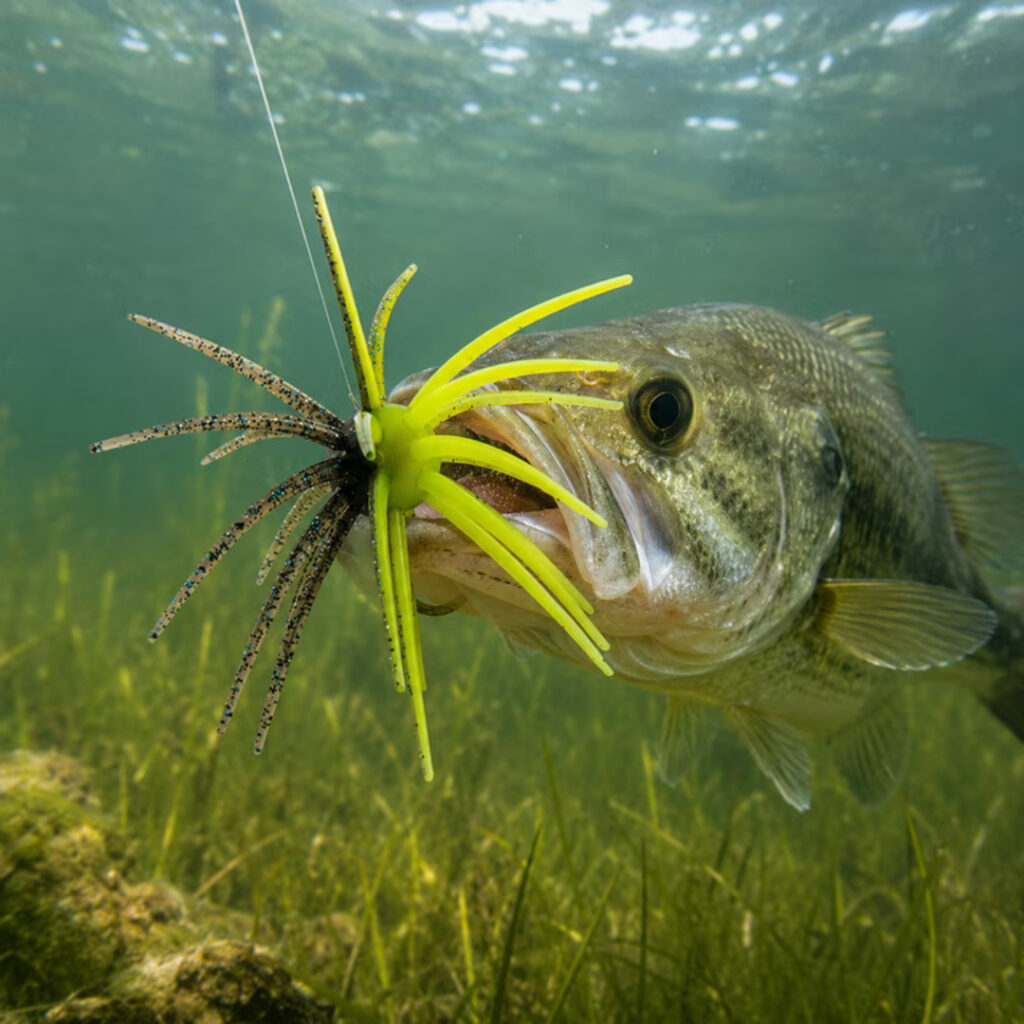
Urchin baits for bass look like a lure designer lost a bet: a compact plastic core buried under a forest of legs, fibers, or tentacles. Yet in 2026, that strange silhouette has moved from Japanese-tackle curiosity to one of the season’s most consequential tournament trends.
This is no longer a social-media bait living on novelty. Across bass fishing tournament coverage, the profile is appearing in winning programs, product launches, hook systems, and purpose-built storage. The real story is not that anglers found another weird lure. It is that the lure exposed what pressured bass still struggle to ignore.
Tournament Wins Turned a Curiosity Into a Category
The craze accelerated when the bait became difficult to dismiss. Chris Johnston used a Hideup Coike Full Cast during his 2026 Santee Cooper victory, finishing with 113 pounds, 12 ounces and winning by 19 pounds, 12 ounces. He did it without forward-facing sonar driving the pattern, skipping and pitching around overlooked docks.
A month later, Jason Christie won at the Pasquotank River with 92 pounds, 7 ounces. An urchin-style bait became the key lure around a current-swept dock, while several other top finishers used similar profiles around cypress trees, stumps, and shallow wood.
That is tournament proof, not showroom hype. Two very different fisheries showed that the profile could work as a slow visual target and a cover-oriented casting bait.
Why Urchin Baits for Bass Keep Getting Bit
Most bass lures suggest something recognizable: shad, crawfish, bluegill, worm. An urchin bait offers controlled ambiguity. Its center creates a meal-sized target while dozens of appendages move independently, even when the angler barely moves the rod.
Bass in pressured water have seen endless straight worms, minnow baits, jigs, and creature plastics. The urchin may work because it looks alive without looking familiar, holding shape while its outer profile breathes and expands.
Its fall matters just as much. Lightly weighted versions can stay visible longer, while larger, denser models push more water. The lure looks vulnerable without appearing dead, giving following fish extra time to commit.
The Sonar Story Is Only Half the Story
Forward-facing sonar helped anglers understand the bait by showing how fish reacted to twitches, pauses, weight changes, and fall rate. But the strongest evidence from 2026 is that this is not a sonar-only bait. Johnston’s dock pattern and Christie’s river-cover program showed that it can be skipped, pitched, flipped, or blind-cast where a fish should live.
That versatility explains the rapid spread. Detailed pro-level urchin rigging lessons show anglers using single hooks, trebles, and multi-point systems, often with an internal nail weight to control the fall.
The profile can behave like finesse tackle in open water and power tackle around cover. Few lure trends cross that line so naturally.
ICAST Showed the Craze Is Bigger Than One Bait
ICAST 2026 confirmed that manufacturers see more than a passing import story. Rapala CrushCity’s The CEO 21 won Freshwater Soft Lure, G-Ratt’s Urchin Rig won Terminal Tackle, and BUZBE’s Urchin Bait Box won Tackle Management. The 2026 New Product Showcase winners turned one lure shape into a product ecosystem.
Brands are now competing over density, appendage shape, hook orientation, weighting, weedlessness, and storage. Some innovation will improve the technique. Some will simply add more legs to the shelf.
Match the Rig to the Job, Not the Hype
The best starting point is not the most expensive bait. It is the presentation that fits the cover, depth, fish size, and tournament pace.
| Fishing situation | Starting presentation | Why it fits | Common failure |
|---|---|---|---|
| Suspended fish in open water | Light internal weight with exposed hook | Maximizes hover and slow fall | Adding too much weight |
| Docks, laydowns, and sparse wood | Weedless single or double hook | Improves skipping and cover contact | Exposed points snagging |
| Dirty water or larger largemouth | Bigger, denser urchin | Adds profile and displacement | Fishing it too delicately |
| Clear water and pressured smallmouth | Compact profile with minimal weight | Keeps action subtle | Rushing the fall |
| Grass edges and isolated targets | Moderate weight with snag-resistant rig | Balances penetration and hang time | Burying the bait in cover |
Fall rate usually matters before color. Too much weight can erase the slow, expanding movement that separates the bait from conventional plastics. Too little can keep it from reaching the strike zone efficiently.
Material care matters, too. Some elastomer-based urchins can react badly when stored against conventional soft plastics; Hideup warns that mixed storage can cause melting. That makes rigging discipline part of the technique.
The Next Test Is Whether Anglers Learn the Bait
The category’s biggest risk is not that bass suddenly stop biting it. The risk is that anglers treat the profile as an automatic answer. A lure that can hover, skip, soak, fall, and pulse still demands decisions about target, depth, speed, and hook exposure.
Watch whether tournament anglers keep using urchins after the launch buzz fades, especially in events without unrestricted sonar. Also watch whether hook systems improve around cover and whether regional events keep producing results across different water types.
The survivors will not be the baits with the most appendages. They will fall correctly, stay rigged, clear the intended cover, and give anglers repeatable control.
Urchin Baits for Bass Have Already Changed the Box
The craze will eventually lose some fever. Every hot lure does. But urchin baits for bass have earned more than a temporary slot because they solve a modern tournament problem: holding a compact, living-looking target in front of educated fish without showing them the same old shape.
They will not replace the jig, worm, or minnow bait. Their lasting value is more specific: a presentation that can be finesse or power, sonar-guided or blind cast, subtle or bulky. Anglers who understand that distinction will keep catching fish after the craze moves on.