

Tournament bass fishing lessons are most useful when they stop looking like tournament fishing. Weekend anglers do not need sponsor decks, a dozen rigged rods, or a stopwatch beside the console; they need the decision habits that keep professionals from wasting limited hours. The real advantage is not fishing harder but recognizing sooner when the lake has rejected the plan.
That same principle sits behind practical bass fishing tactics: narrow the variables, make each stop answer a question, and let current conditions outrank yesterday’s confidence. A recreational trip becomes more productive when it has enough structure to create feedback without turning a day on the water into work.
The Real Edge Is Decision Discipline
Tournament coverage naturally focuses on lures, weights, and winning areas. Those are visible. The less glamorous skill is deciding how long to stay, what evidence justifies a move, and which clue deserves more attention.
Professionals work under consequences. A poor decision costs fishing time, position, or weight. Recreational anglers face a softer version of the same problem: a four-hour morning can disappear on a familiar point that “should” produce.
Before fishing an area, decide what would make it worth staying. That might be a bite, visible forage, useful current, healthy grass, a temperature change, or repeated marks at the right depth. Hope is not evidence. When none of those signals appears, leaving is not impatience. It is good water management.
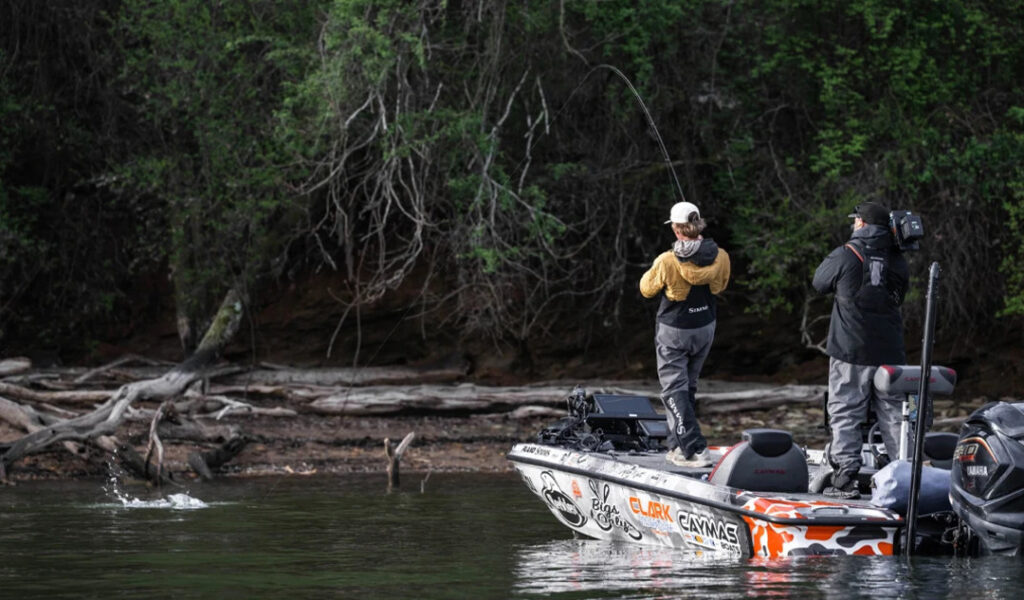
Tournament Bass Fishing Lessons Start With a Clock
Elite-level events make time visible. Bassmaster competition days include fishing, travel, and the return to check-in, while practice is used to prioritize areas, water conditions, and productive techniques. The details of how Elite events work reveal why pros treat every run and stop as part of one limited schedule.
A weekend angler can borrow that discipline without rushing. Divide the trip into loose windows: search, confirmation, adjustment, and finish. If the first hour produces no meaningful clue, change either location, depth, or presentation—not all three at once.
This prevents two common time losses. The first is camping on dead water because it produced last month. The second is frantic lure rotation that changes so many variables that no conclusion is possible. Change one thing deliberately, then watch what happens.
Stop Collecting Spots and Start Building Patterns
A spot is a coordinate. A pattern is an explanation.
Catching one bass beside a dock does not prove a dock bite. Was it the darkest corner, the deepest post, the windblown side, the first dock inside a pocket, or the only dock near submerged grass? The answer tells you where to cast next.
Tournament anglers look for something repeatable because one productive place can be occupied, pressured, or emptied. Recreational anglers benefit for the same reason. A lake becomes smaller when bites are converted into shared characteristics.
After every strike, note depth, cover, lure position, retrieve speed, sunlight, wind, and casting angle. You do not need a spreadsheet in the boat. A short phone note is enough. Record the reason, not just the location. That habit turns isolated catches into a plan you can test elsewhere.
What to Borrow—and What to Leave Behind
Not every tournament behavior improves a casual fishing day. The best translation keeps the discipline while removing the stress.
| Tournament habit | Useful weekend version | What to avoid |
|---|---|---|
| Strict time management | Give unproductive areas a defined window | Racing through water without observing it |
| Multiple backup patterns | Carry one shallow, one mid-depth, and one deep option | Rigging every technique you own |
| Practice and research | Check weather, water level, seasonal stage, and forage | Treating old reports as current truth |
| Pattern replication | Revisit similar cover, depth, and conditions | Running only to named community holes |
| Catch tracking | Note bite time, angle, cover, and depth | Logging details without changing decisions |
| Format-based strategy | Decide whether the trip targets numbers, size, or learning | Judging every trip by total fish caught |
Tournament formats show why the goal matters. The current Bass Pro Tour uses catch-weigh-immediate release and counts every scorable bass, rewarding sustained production and efficient decisions. Its 2026 competition format differs from a biggest-five event, where upgrading quality can matter more than catching another small fish.
Set your own format before launching. A numbers day, a big-fish day, and an exploration day require different choices. A clear objective prevents bad comparisons and keeps a useful trip from feeling unsuccessful.
Pressure Signals That Should Change Your Plan
The biggest risk in borrowing tournament thinking is becoming too committed to the plan. Discipline is not stubbornness. A plan earns more time only when the lake keeps supplying evidence.
Watch for signals that the original approach is weakening: bait leaving an area, wind switching sides, current stopping, sunlight removing a shade edge, water clarity changing, or several boats repeating the same stretch. Even a follow, short strike, or missed fish can show that bass are present but unwilling to finish.
The first adjustment should be precise. Change the casting angle before abandoning the cover. Change speed before changing lure category. Move slightly deeper before running across the lake. Small adjustments preserve what you have already learned.
The second risk is copying the visible choice without understanding the reason. A pro’s winning bait may have matched a particular forage size, depth, cover type, or current window. Buying the lure reproduces the object, not the decision. The transferable lesson is the relationship between presentation and conditions.
Tournament Bass Fishing Lessons Without the Tournament
The strongest tournament bass fishing lessons do not make recreational fishing more complicated. They remove wasted motion. Define the trip, manage time in broad windows, turn bites into patterns, and change one variable at a time.
The opportunity is not to imitate a professional’s intensity. It is to borrow professional clarity while keeping the freedom that makes weekend fishing enjoyable. When every stop has a purpose and every bite improves the next decision, fewer hours are lost to dead water—and more casts are made where the lake is giving something back.