

The 2026 Lake Conroe results available through September 29, 2026, gave a clear but limited record of local angler performance: steady weekly participation, several bass over six pounds, and one national-style single-fish event in March that pushed the top mark past 11 pounds. The safest reading is not that one pattern controlled the lake all year. The documented record shows that different formats rewarded different kinds of efficiency.
For a tournament historian, that distinction matters. A five-fish Sunday team event measures consistency across a morning. A big-bass format measures one high-value bite. A championship field measures pressure after a season of local competition. Lake Conroe’s reported 2026 results included all three, which makes the sample useful without asking it to say more than the numbers support.
Lake Conroe Results And The September Pattern
What Lake Conroe Results Show About Weight
The September reports showed a practical split between solid five-fish bags and standout individual bass. On September 27, 2026, the Stow-A-Way Marina Sunday Morning event listed 16 teams, with Gary Conner taking Big Bass at 5.48 pounds and JD Barela and Dustin Bosquez weighing five fish for 18.40 pounds. On September 20, 2026, 12 boats were listed; Matt Beggs had Big Bass at 5.27 pounds, Dustin and Matt Beggs weighed five for 15.89 pounds, and Bobby Reaves brought in five for 14.07 pounds, according to the Lake Conroe tournament results archive at Lake Conroe results.
Those two September Sundays did not produce the largest bass in the reported sample, but they did show why local team events reward steadiness. A 15- to 18-pound range can be decisive in a modest local field when the number of boats sits between 12 and 16. That kind of outcome usually says less about one dramatic fish and more about making enough scoring casts to finish a limit.
The Championship Weight Gap
The September 19, 2026, ConroeBass Tuesday Series Championship added a different angle. The event concluded with 28 teams. Collin Kelly and Mason Hoke won with 30.66 pounds and a listed prize of $2,400. Cohen Cox and Zane Parker followed with 30.09 pounds and $1,250. Spencer Fair and Caylee Fair were third with 22.53 pounds and $700.
The narrow gap between first and second, 0.57 pounds, is the kind of margin that defines a championship record. The available figures do not explain where those fish were caught, what baits were used, or how many bites were lost. They do show that two teams cleared 30 pounds in the same championship, while third place sat more than eight pounds behind the winner. In event-specific terms, that points to a top tier that separated sharply from the field on weight, not just placement.
Big Bass Marks Carried The Weekly Story
Six-Pound Fish Were Not Rare In The Sample
Across the eight reported weekly events that listed a Big Bass, six topped six pounds. Chad Brown had 6.71 pounds on September 13, John Sheets reached 7.97 pounds on September 6, Gary Conner posted 6.08 pounds on August 30, Colby Bryant caught 7.90 pounds on August 23, Knox Hitt and Case Rutherford had 6.91 pounds on August 16, and Joe Byrd led July 19 with 8.21 pounds.
That record does not prove a lakewide trend by itself. It does show that, in this set of documented tournaments, a six-pound class fish was a realistic winning Big Bass mark through late summer and early fall. For anglers reading Lake Conroe results after the fact, that is the performance signal: one larger bite repeatedly mattered, even when the main payout structure also depended on total team weight.
Joe Byrd’s July Bag Stands Apart
The July 19, 2026, result remains the strongest five-fish entry in the local weekly sample provided. Joe Byrd won Big Bass at 8.21 pounds and also weighed a five-fish bag of 31.17 pounds. Mario Botan and AJ Taylor followed with five for 24.07 pounds. The gap between first and second was 7.10 pounds, a large separation in a 13-team event.
That July result sits beside the September championship weights as one of the clearest performance markers in the set. Byrd’s day combined both measures that local bass events value: the biggest individual bass and the strongest limit. When the same angler controls both categories, the result is less vulnerable to interpretation than a split outcome where one team wins the bag and another takes the single-fish award.
Participation Numbers Matter Locally
Field Size Framed The Results
The weekly Stow-A-Way results in the sample listed fields of 13, 19, 14, 17, 18, 15, 12, and 16 boats or teams. Using only those reported counts, the average field size was 15.5. That is not a measure of the total Lake Conroe tournament scene, but it does show a repeat local structure with enough participation to make weights meaningful.
For the community around a lake, field size matters because it reflects organized use of ramps, marinas, weigh-in areas, and local services. The records here cannot quantify spending at fuel docks, restaurants, lodging, or tackle shops. They do show recurring tournament activity anchored to named local events. For readers comparing how community-centered sports coverage is presented across sites in the same network, a related site in the same network offers a point of reference.
Recurring Names Show Competitive Continuity
Several names appeared more than once in the documented results. Gary Conner had Big Bass on September 27 and August 30, and he also appeared with Daryl Stewart in team results on August 30 and August 16. Case Rutherford appeared with Kasen Clark in the August 23 winning stringer of 25.54 pounds and with Knox Hitt in the August 16 result that included Big Bass at 6.91 pounds and five fish for 20.67 pounds.
This does not allow a full angler-of-the-year ranking. The source set does not include every entry, every finish, or a points table. It does support a narrower statement: repeated appearances by the same anglers and teams suggest continuity within the local competitive group. That continuity is one reason weekly tournament records become useful historical material rather than isolated score sheets.
The March Big Bass Classic Changed The Scale
A Single Fish Decided A Major Format
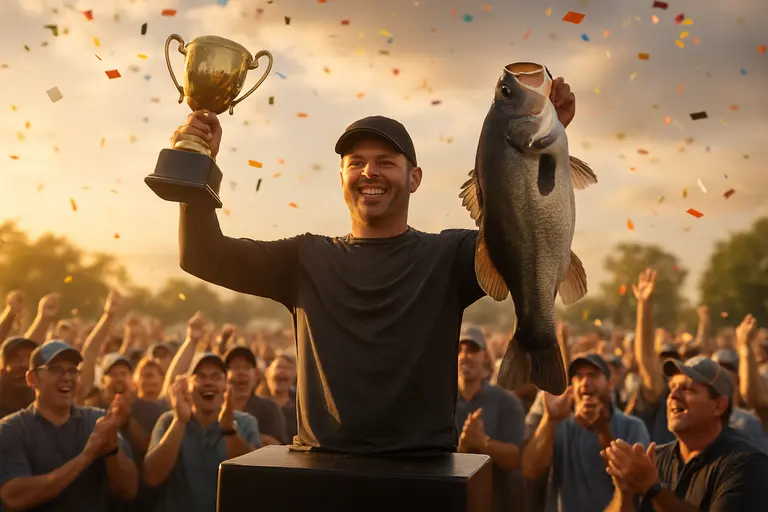
The March 3-5, 2026, Turtlebox Audio Lake Conroe Big Bass Classic brought a different standard because it was built around single-bass weight rather than five-fish limits. Tristan Stewart won with an 11.65-pound bass, edging Lee Allen’s 11.63-pound fish by 0.02 pounds. Andrew Smith finished third at 10.40 pounds, according to the Big Bass Tour’s event report on Stewart’s Lake Conroe win.
The top two fish being separated by two-hundredths of a pound is historically useful because it shows how unforgiving the format can be. In a five-fish event, an angler can overcome one smaller keeper with four stronger fish. In a big-bass contest, the leaderboard can turn on a difference smaller than the weight of a soft plastic bait package. That is not drama added after the fact; it is what the reported numbers show.
The March result also placed the local lake in a wider tournament context. The weekly results showed regular club and local-series competition. The Big Bass Classic showed Lake Conroe could produce double-digit fish under a larger event banner. Those are different records, and they should not be merged into one ranking. They do, however, belong in the same seasonal file.
Lake Conroe Results In Local Tournament Context
What The Record Can And Cannot Tell Us
The available Lake Conroe results are strong enough to identify performance markers: Byrd’s 31.17-pound July bag, the 30-pound championship duel between Kelly-Hoke and Cox-Parker, Stewart’s 11.65-pound March bass, and a late-summer run of Big Bass marks above six pounds. They are not strong enough to prove a single lake pattern, a best technique, or a complete ranking of every angler who competed in 2026.
That caution is part of good tournament history. Scoreboards tell us who won, by how much, and under which format. They rarely tell the whole story of practice, boat position, missed bites, water movement, or decision-making unless those details are documented. A fair reading keeps the analysis tied to the weigh-in record.
As a local record, the 2026 file showed a competitive Lake Conroe scene with regular participation, recognizable names, and several high-end catches. The strongest evidence came from repeated weigh-in figures, not from claims about patterns that were not reported. That is why these results are valuable: they preserve the measurable side of a fishing community while leaving room for future records to fill in the rest.