

Forget everything you thought about fishing with grandpa. The quiet pastime has evolved into something like an e-sports league with life jackets. Junior divisions are changing the game of competitive fishing.
In Illinois, there are 324 high school fishing teams and nearly 15,000 participants. That’s more student competitors than some states have baseball players. These aren’t casual outings – they’re building a talent pipeline that would make Friday Night Lights look like a pickup game.
The system operates with Guitar Hero-level precision. Age brackets progress from Rookie (8-11) to Prospect (12-14) to Challenger (15-18). Each tier comes with specific boat rules and strategic complexity. It’s more sophisticated than most school sports programs.
Teens analyze water temperatures like marine biologists while learning fish biology and weather patterns. Who needs dystopian fiction when you’ve got competitive youth fishing tournaments teaching real-world STEM skills through hands-on learning?
Mentoring Opportunities
Think Jedi training meets competitive fishing. At Bass Lake, mentorship isn’t about holding hands. It’s about building instincts. Coaches work like tactical operatives, keeping a 50-yard distance and using walkie-talkies only.
This isn’t fishing 101. It’s advanced aquatic strategy. Mentors teach juniors to read water conditions like meteorologists analyze weather. They focus on making decisions, not choosing lures.
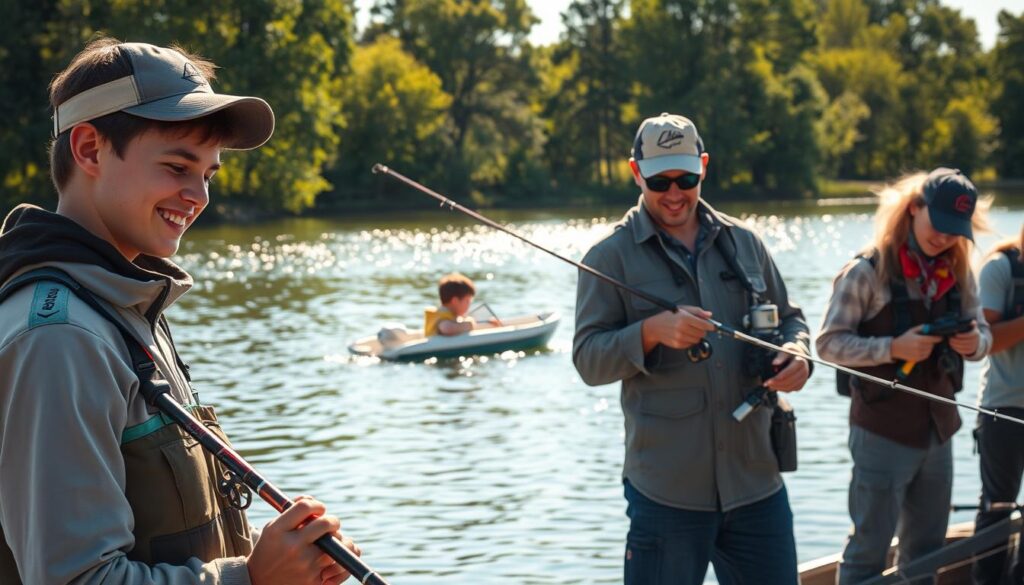
Programs like TBF Junior Anglers and B.A.S.S. High School Nation offer serious support. They provide $1 million liability insurance, educational workbooks, and paths to national competitions. It’s like getting a fishing MBA without the debt.
Local tackle shops become leadership incubators, funding future pros. The real magic is when these youth programs create champions who think ahead.
At bass lake, mentorship means teaching kids to become their own best coaches. The buffer zone isn’t about distance. It’s about growing independence. Walkie-talkie communication forces strategic thinking, not dependency.
Safety First
If the TSA decided to host youth fishing tournaments, they’d look at our safety protocols and immediately request cross-training. We approach safety with the same intensity that Gordon Ramsay brings to kitchen inspections. Instead of checking lamb chops, we check life jackets.
Our equipment audit process would make a NASA engineer nod in approval. Every boat undergoes what we call the “Triple Crown” inspection:
- Mandatory life jackets that actually fit (that vintage 1998 oversized model won’t cut it)
- Throwable flotation cushions positioned like emergency exits on a plane
- Lanyard stop switch tests that get more attention than your first cast
We’ve turned line test verification into an art form. Claim your braid is 10lb test? We’ll verify that faster than fact-checkers during election season. Lure size restrictions are enforced with more precision than a baseball umpire’s strike zone.
Livewell inspections happen with surgical precision. Why? Because keeping fish alive isn’t just about avoiding penalties – it’s conservation ethics that would make Jacques Cousteau proud. Functioning livewells are non-negotiable, treated with the same importance as the boat motor itself.
The most dangerous element on the water isn’t the equipment. It’s complacency. That’s why our safety culture treats a $3 lure with the same scrutiny as a $300 depth finder. In youth fishing tournaments, we prove that extreme safety and extreme fun aren’t mutually exclusive concepts.
Parents can rest easy knowing we’ve eliminated more variables than a statistics professor. Because the only thing we want kids catching is fish – not problems.
Making It Fun and Fair
Imagine a fishing tournament where everyone cheers each other on. Welcome to Bass Lake’s new way of fishing for kids. It’s not your old-school fishing contest; it’s competitive kindness. Here, being kind and learning together is more important than winning.
The system is like video game matchmaking but with real fish. Newbies get the right challenges, and experts face tough opponents. Everyone moves up in skill levels, just like in a video game.
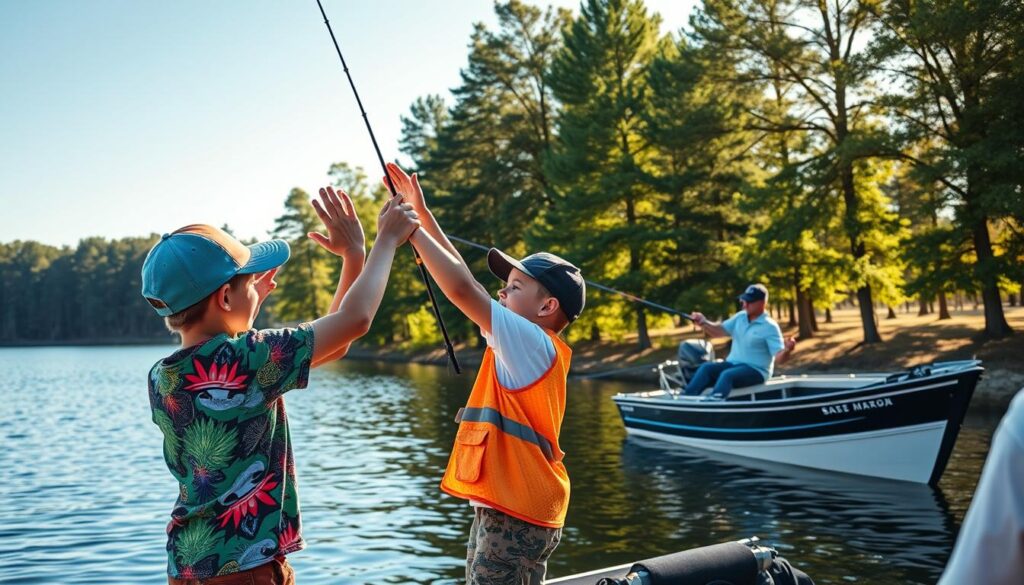
I’ve seen 14-year-olds beat their parents with special gear. Instead of being upset, the adults cheer them on. It’s like Hogwarts houses competing but everyone gets along.
TikTok dances pop up between fishing casts. Old fishing tricks are shared like family secrets. It’s a place where everyone wins and makes new friends.
The fairness here is unmatched. Everyone knows how to get better, and everyone has the same chance. It’s a place where:
- Siblings work together instead of fighting
- Dad jokes are used as secret plans
- Everyone leaves with new skills and friends
The juniors bass lake program has found a way to make competition fun and educational. Kids share tips and celebrate each other’s wins. It’s fishing for the next generation, blending old traditions with new ideas.
This isn’t just about catching fish. It’s about growing up through fun and fair play. They’ve shown that being fair and having fun can go hand in hand in youth sports. It’s a mix of new and old, like a perfect recipe.
Family Involvement
Forget about board games. The real bonding happens when you’re trying to outsmart a clever bass. Our youth fishing tournaments turn family into “aquatic special ops” teams.
Imagine this: Mom picks lures like a Navy SEAL. Kids use sonar like hackers. And Grandpa? He’s a walking Fishbrain app with years of local knowledge.
The Hopkins brothers show what we mean. Their rivalry turned into “competitive cooperation.” One brother said: “Beating my brother? Priceless. The trophy? Icing on the cake.” This is the magic of our family division tournaments where fishing puns are emotional support.
Here’s why multi-generational teams win:
- Grandpa’s wisdom is your secret weapon – like cheat codes for the lake
- Sibling ceasefire hours where the only argument is who caught the bigger fish
- Parent-coach partnerships that make Friday night lights look easy
The real trophy is the bonds stronger than 50-pound test line. When there’s a 4-pound bass on the line, no one asks “are we there yet?”
These youth fishing tournaments offer something rare today: undivided family attention. The only screen that matters is the fish finder. It’s about catching moments that become family legend, not just fish.
Scholarships
Forget the bass—the real trophy here is cold, hard tuition money. Junior bass tournaments offer full scholarships, unlike other sports. Winners get $5,000, runners-up get $2,500, and junior winners get $1,000 plus gear.
Jesse Thompson didn’t just beat adults; he funded his degree with his winnings. That’s smarter than any TikTok dance. TBF and B.A.S.S. programs help anglers join college teams and pro circuits.
These junior bass events at your local lake are more than just bragging rights. They’re like Ivy League tryouts for anglers who know moon phases better than calculus. The Bass Fishing Hall of Fame also offers scholarships for fisheries students.
Your lucky hat might smell like week-old shad, but it could also smell like a college diploma. That’s a catch worth reeling in.