

The best fishing line for bass is not automatically the strongest spool or the least visible one. It is the line that lets a specific lure run correctly, drives the hook without overpowering it, and survives the cover between the strike and the boat.
The Best Fishing Line for Bass Starts With the Lure
Many anglers begin with pound-test, but that puts the decision in reverse. Start with the lure, identify the cover it must cross, consider the rod and reel, and choose strength last. Line changes lure behavior through its diameter, stretch, buoyancy, visibility, and abrasion resistance.
Fluorocarbon helps a bottom-contact bait maintain a direct path. Monofilament rides higher and adds forgiveness. Braid delivers immediate feedback and strong pulling power at a small diameter. A useful freshwater line comparison separates those materials by performance traits that matter on the water.
That framework keeps decisions simple: match the line to what the lure needs to do, then refine for the conditions you are fishing. Anglers who flip that order often chase strength or invisibility and end up sacrificing the very action that makes a bait effective.
Mono, Fluoro and Braid Solve Different Problems
Monofilament is manageable, affordable, and forgiving. Its stretch cushions surging fish and protects treble hooks, while its tendency to stay higher suits many surface baits.
Fluorocarbon offers lower visibility, solid sensitivity, and dependable bottom contact. It fits Texas rigs, jigs, finesse leaders, and many subsurface techniques, but can be stiff in heavier diameters.
Braid has very low stretch, excellent sensitivity, and high strength for its size. It excels in vegetation, on long casts, and as a spinning main line, but its visibility and lack of shock absorption can work against some presentations.
| Line type | Best fit | Main trade-off | Common bass starting range |
|---|---|---|---|
| Monofilament | Topwater, treble-hook baits, simple setups | More stretch, less direct feel | 10–17 lb |
| Fluorocarbon | Bottom-contact, clear water, subsurface | Stiffer handling, knot care | 8–20 lb |
| Braid | Frogs, vegetation, long casts, spinning main | High visibility, little shock absorption | 15–30 lb spinning; 40–65 lb heavy cover |
Those ranges overlap because no single setup covers every situation. Water clarity, cover density, and casting distance all push the choice in one direction or another, even within the same technique.
Pound-Test Should Follow Cover and Hook Style
Pound-test does not match fish weight. It is one part of a system that includes rod, drag, knots, and abrasion, and it also affects casting distance and spool capacity.
Cover sets the floor. Finesse in open water may use 6- to 10-pound fluorocarbon. General baitcasting often falls between 12 and 17. Around wood, rock, or thicker vegetation, anglers step up to 15- or 20-pound fluorocarbon or 40- to 65-pound braid when fish must be pulled clear.
Hook style matters. Treble hooks benefit from forgiveness, while heavy single hooks need firmer contact. Spinning tackle often favors thinner lines for casting and control, while casting gear can manage heavier diameters more comfortably. The broader line-selection fundamentals point back to matching line with conditions and equipment ratings.
Practical Line Setups for Common Bass Techniques
For walking baits and poppers, 12- to 17-pound mono keeps the presentation high and softens an early hookset. Heavy-cover frogs call for 40- to 65-pound braid to cut through vegetation. Solid topwater lure tactics still matter, because timing cannot be fixed by line alone.
Jigs and Texas rigs pair well with 12- to 17-pound fluorocarbon in open to moderate cover, going lighter for finesse and heavier around abrasion. Crankbaits can use mono for cushion or thinner fluorocarbon for added depth and feel.
Spinnerbaits and swim jigs sit in between. Fifteen- to 20-pound fluorocarbon is a steady starting point, with mono for more give and braid in grass when the rod and drag supply enough cushion.
Braid-to-Leader Is Useful, Not Automatic
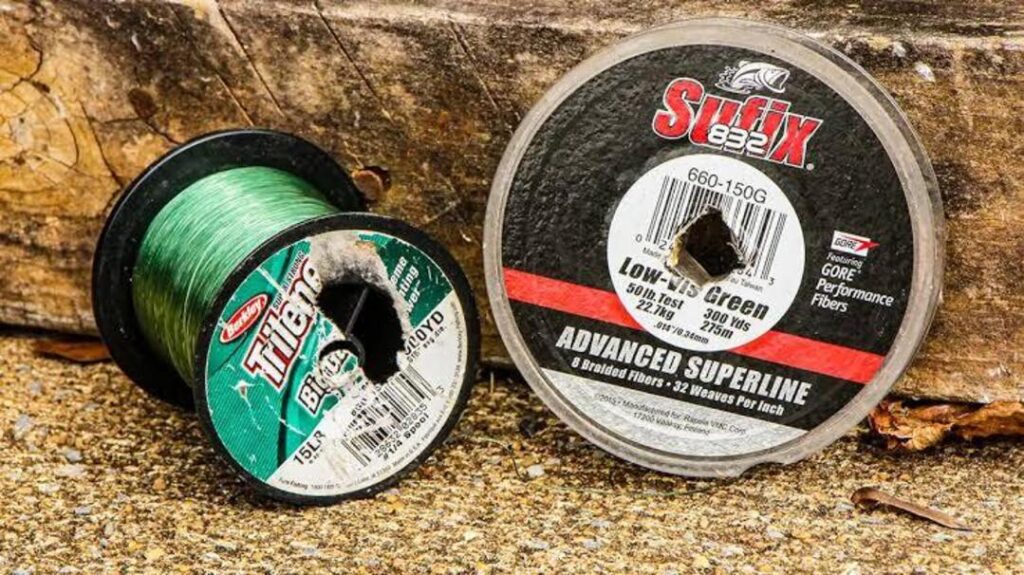
A braided main line with a fluorocarbon leader shines on spinning tackle. Braid casts cleanly, resists coils, and transmits subtle bites, while the leader reduces visibility near the lure.
But a leader is a compromise, not a universal upgrade. In heavy vegetation or around abrasive cover, a direct braid connection removes a failure point. On casting gear, repeated knot passes through the guides can add friction and variability. Leader length and connection quality also matter, especially when casting distance or repeated hooksets are involved. A poorly tied connection or overly long leader can introduce more problems than it solves.
The Clues That Say Your Line Choice Is Wrong
Problems usually show up before they cost a fish. A crankbait that will not reach depth, a topwater that noses down, or a lure that feels disconnected often signals the wrong material or diameter. Unexplained break-offs or slipping knots point to handling or selection issues.
Inspect the working section of line after contact with rock or wood, retie when abrasion appears, and adjust drag to match the hook style. Small changes—material, diameter, or added forgiveness—often restore control.
The best fishing line for bass is the one that removes the most likely failure from the situation in front of you. Choose buoyancy and stretch for lure behavior, strength for cover, and balance the system with rod action and drag.
When that decision is deliberate, the line becomes part of the presentation, leading to cleaner hooksets, fewer break-offs, and more fish that reach the net.