

Dirty water changes bass fishing fast, and it changes the margin for error even faster. When visibility collapses, the difference between an effective presentation and a wasted cast often comes down to whether a fish can find the lure at all.
That is why muddy water bass fishing demands a different mindset right now. I do not treat stained or muddy conditions as a minor inconvenience; I treat them as a complete tactical shift that forces me to rethink size, color, vibration, and speed from the first cast forward.
Why Muddy Water Forces Better Decisions
In clean water, bass have time to study a lure from farther away. In muddy water, that advantage disappears. The fish are no longer getting a long, clear look at a bait, which means they must rely on a tighter combination of movement, contrast, and vibration to locate and strike.
That is the point where many anglers lose efficiency. They keep throwing the same subtle offerings they trust in clearer conditions, then wonder why fish are not committing. I have learned that muddy water is not the time to fish small, blend in, or move too fast. It is the time to make a lure easier to detect and easier to track.
When I adjust correctly, I am not guessing. I am responding to the reality of how bass behave when visibility shrinks and reaction time gets shorter.
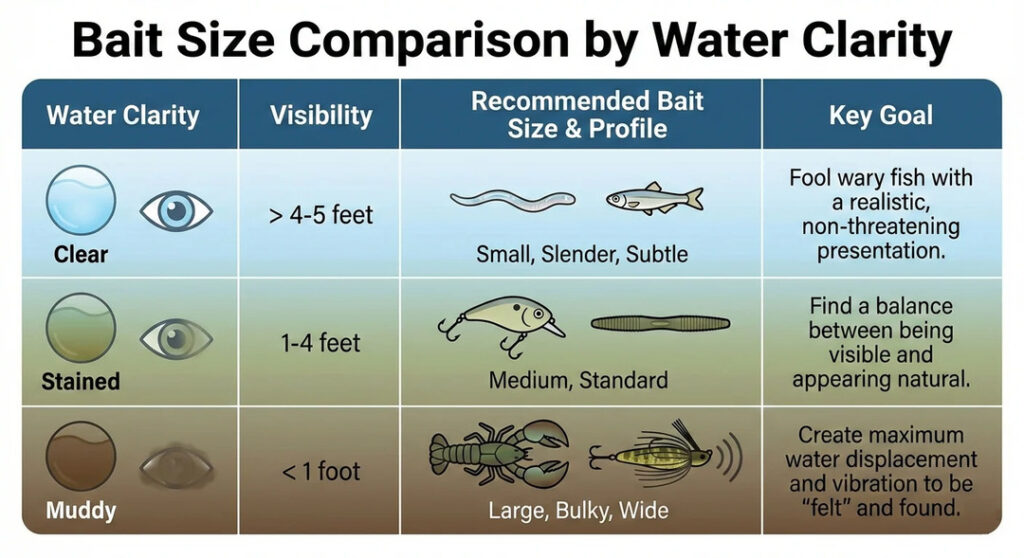
The Four Adjustments That Matter Most
The core of my muddy-water strategy is straightforward, but each part supports the next. I want the fish to notice the bait, follow it, and then have enough time to strike with confidence.
- I increase lure profile so the bait gives bass a more obvious target.
- I choose darker or brighter colors to create stronger contrast.
- I rely on lures with more vibration so fish can track them more easily.
- I slow the retrieve enough to keep the bait in the strike zone longer.
These are simple changes, but together they create a presentation that is far more readable in dirty water.
Bigger Profiles Create A Clearer Target
The first move I make is usually to size up. A bigger lure profile gives bass a stronger silhouette and a more noticeable target in low-visibility conditions. That does not mean I automatically throw oversized baits all day, but I do lean away from finesse presentations that can vanish in muddy water before a fish ever locks on.
A larger spinnerbait, a bulkier jig, or a soft plastic with more body all make sense because they improve the lure’s presence. Bass do not need fine detail in these situations as much as they need something they can identify quickly at close range. The added size also helps the bait push more water, which supports the vibration side of the equation.
I have found that a slightly larger presentation often does more than improve visibility. It improves commitment. Fish that might swipe at a tiny lure in muddy water are more likely to fully eat something they can track with certainty.
Contrast Matters More Than Realism
Color selection changes meaning in muddy water. In clear water, natural forage imitation often leads the decision. In dirty water, contrast takes over. I am no longer asking what looks most lifelike from several feet away; I am asking what separates best from the background at close range.
That is why I tend to reach for darker or brighter colors. Dark shades such as black and blue can create a strong silhouette, particularly when the water is heavily stained. Bright patterns, especially chartreuse-based options, can also perform well when they provide enough flash and visibility to stand out in the murk.
The table below shows how I think about those adjustments on the water.
| Condition Need | My Typical Adjustment | Why It Helps |
|---|---|---|
| Fish cannot see far | Bigger lure profile | Creates a stronger target and silhouette |
| Background is muddy and dull | Darker or brighter colors | Improves contrast and visibility |
| Fish struggle to locate bait | More vibration | Helps bass track lure movement |
| Fish have less time to react | Slower retrieve | Keeps lure in range longer |
For anglers wanting a technical baseline on muddy water bass fishing, the essential principle is the same: the lure must separate itself from the environment well enough for bass to locate and strike it.
Vibration Becomes A Primary Trigger
If muddy water reduces sight distance, vibration becomes one of the most valuable tools in the box. I want lures that displace water and create a detectable pulse. That usually pushes me toward spinnerbaits, bladed jigs, squarebill crankbaits, and jigs with enough bulk to move water effectively.
This matters because bass are often tracking with more than their eyes in these conditions. A lure with stronger vibration gives them a better chance to locate its path and time the strike. In practical terms, that means I am often looking for thump rather than finesse.
A lure that can be felt often outperforms one that only looks good in the boat. That is one of the most important truths in muddy water. If the bait does not announce itself, it may never become part of the fish’s decision-making process at all.
Slowing Down Improves Strike Quality
Even with the right color and vibration, presentation speed can ruin the whole setup. When bass are dealing with reduced visibility, they need a little more time to find the lure and line up on it. If I burn a bait past them at clear-water speed, I may never know whether a fish tried to react and lost it.
That is why I slow the retrieve. I am not always crawling the lure, but I am almost always backing off enough to extend the strike window. A slower presentation helps bass follow the bait without losing contact, and it allows the lure to stay near cover, edges, and ambush points longer.
This is especially important when I am fishing around wood, grass lines, rock, or shoreline targets. In muddy water, bass often position tighter to structure and wait for prey to get close. Slowing down gives them a better chance to commit fully rather than just bump or miss the bait.
Why This Strategy Matters Right Now
This matters now because water conditions can change quickly after rain, runoff, wind, or lake turnover, and bass anglers who fail to adjust usually fall behind just as quickly. Muddy water does not shut down fishing opportunities. It simply rewards anglers who understand that bass still feed aggressively when the presentation matches the conditions.
I have come to see muddy water as less of a problem and more of a test. It forces sharper decisions, more discipline, and a better understanding of how fish locate prey when visibility disappears. When I choose a bigger profile, create stronger contrast, add more vibration, and slow the retrieve, I am not simplifying the challenge. I am solving it in the most direct way possible.
Right now, that matters because unstable water conditions are no longer occasional disruptions; they are part of modern fishing reality. The anglers who adapt fastest are the ones who keep catching.