

The most revealing hours on a bass lake often arrive before the first raindrop. I have learned, after enough unstable-weather mornings on pressured water, that bass fishing before a storm is less about luck than about reading a brief, highly specific window when fish reposition, bait shifts, and hesitation can cost you the best bite of the day.
That window does not stay open long. Under thickening cloud cover and a changing sky, bass can turn opportunistic, but they rarely spread out evenly across a lake or pond. They gather where movement, cover, and visibility intersect. For anglers willing to fish with pace early and precision later, those late-morning hours can produce the kind of action that ordinary bluebird days often fail to deliver.
Why The Late-Morning Window Matters
I do not treat approaching weather as background scenery. I treat it as structure. In my experience, the period before a storm often compresses the decision-making of the fish. Bass that spent the early morning loosely positioned may slide toward ambush points, patrol edges more aggressively, or push shallow for a short feeding run before conditions deteriorate.
The key distinction is that these fish are not necessarily “easier.” They are simply more committed to locations that let them intercept prey efficiently. That is why bass fishing before a storm favors anglers who think in terms of routes and intersections rather than random casts. I want places where wind meets shoreline, where grass meets open water, where rock gives way to mud, or where wood interrupts an otherwise featureless bank.
Cloud cover helps. So does light wind. Both reduce visual exposure and make bass more comfortable roaming. But comfort does not mean chaos. It means they will often move to the exact kind of places serious anglers should already be targeting.
Where I Start Looking First
When I arrive under unstable skies, I am not hunting the prettiest water. I am hunting the most active water. My first pass is almost always along wind-blown banks, especially those that collect bait or create a subtle color change. Wind is not just surface texture; it is a delivery system that pushes forage and obscures a predator’s approach.
From there, I focus on points, particularly secondary points near shallow flats or creek arms. These are transition spaces, and transition spaces become more valuable when fish are moving. A point lets bass rise, slide, feed, and retreat without traveling far. In pre-storm conditions, that efficiency matters.
I also pay close attention to weed edges and grass lines. Healthy vegetation creates both concealment and oxygen, but the real opportunity sits on the edge. That is where baitfish drift, pause, and break formation. It is also where a bass can stay hidden while monitoring open water. If I see irregularities in the line, a pocket, a cut, a point of grass extending outward, I slow down and work it carefully.
Then come the classic hard-cover elements: wood, docks, and rock transitions. A laydown on an otherwise plain bank can become a feeding station. A dock with shadow and depth change can hold fish even in shallow systems. Rock transitions, especially where chunk rock changes to gravel or gravel shifts to clay, often concentrate the better-class fish because those changes gather both forage and movement.
The Right Baits For Moving Fish
When the surface has ripple and the water carries even a hint of stain, I want a bait that announces itself. This is where spinnerbaits and chatterbaits earn their place. I fish them not only to trigger reaction strikes, but to cover water fast enough to identify where active fish are positioned that day. In unstable weather, location clarity often matters more than lure purity.
Around hard cover, especially shallow wood and rock, I like a squarebill or shallow-running crankbait. The reason is simple: deflection creates indecision, and indecision creates strikes. A crankbait that ticks cover, kicks sideways, and briefly loses its track can look like vulnerable prey in a way that a cleaner presentation cannot.
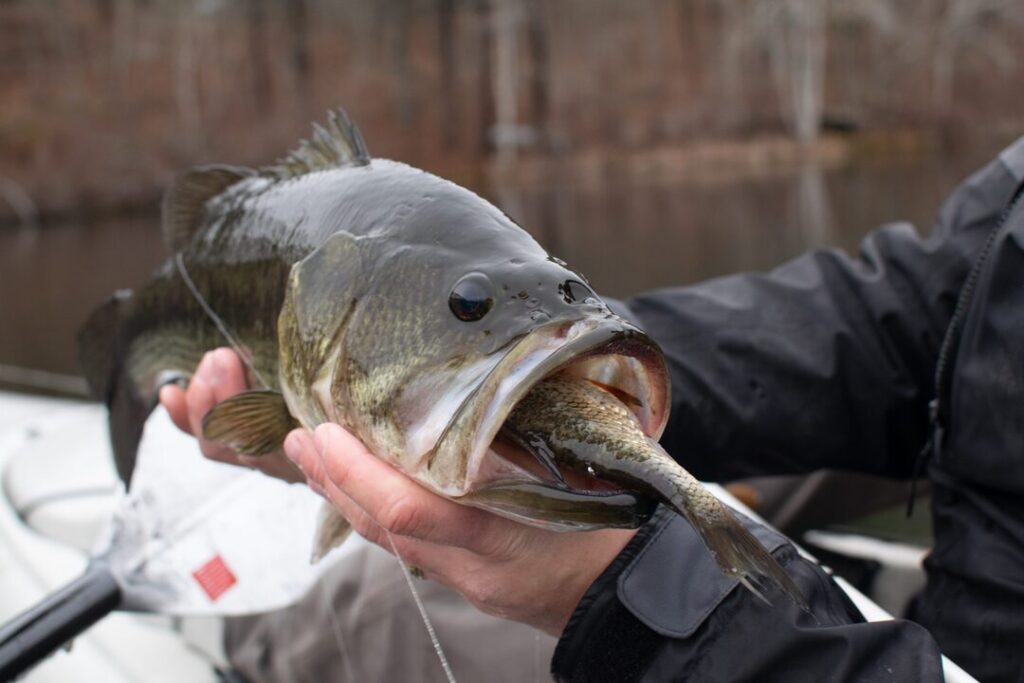
But there is another side to bass fishing before a storm that many anglers miss. Not every fish that shows itself is ready to fully commit. Some follow. Some flare under the bait and fade. Some roll without eating. That is when I reach for a weightless stick worm or fluke-style soft bait. These baits let me show the fish a slower, less intrusive target in the same strike zone without abandoning the area that just revealed activity.
What matters most is sequence. I prefer to begin with a search bait, establish where fish are reacting, and then circle back with a subtler presentation for the ones that seemed interested but unconvinced.
How I Read The Refusal Bite
The refusal bite is one of the most useful signals on the water, and it becomes especially important before weather breaks. If fish are following a moving bait but not striking cleanly, I do not assume the area is poor. I assume I am close.
That is a critical distinction. Too many anglers read a refusal as rejection and leave. I read it as negotiation. A fish that tracks a lure along a grass edge or peels off a dock post to inspect a bait is telling me I have found the right neighborhood. My next job is to adjust speed, angle, or profile.
Sometimes that means making repeated casts at the same target from slightly different directions. Sometimes it means swapping vibration for glide. Sometimes it means letting a soft bait fall longer beside the cover before moving it at all. The best pre-storm anglers I have watched do not panic when bass miss. They tighten the pattern.
For anyone planning around bass fishing before a storm, safety belongs in the same conversation as strategy. The feeding window can be excellent, but no bite is worth staying exposed once thunder closes in.
Why Efficiency Beats Complexity
I have become more convinced over time that the best late-morning storm pattern is rarely elaborate. It is usually a disciplined rotation through high-percentage targets with two or three baits that answer different moods of the fish. The winning formula is often a fast-moving lure to locate activity, a contact bait to exploit cover, and a finesse follow-up when the fish show without finishing.
That simplicity matters because unstable weather shortens attention spans, including the angler’s. It is easy to chase every shoreline, every splash, every promising pocket. The better move is to identify the recurring ingredients, wind, transition, cover, and edge, and fish them with purpose.
Why This Matters Now
The appeal of bass fishing before a storm is not just that it can produce more strikes. It sharpens the way an angler interprets water. These conditions reward pattern recognition, decisiveness, and restraint all at once. They force you to fish the moment in front of you instead of the plan you brought from home.
That is why this topic matters. In a sport increasingly crowded with gear choices, data points, and endless noise, the late-morning pre-storm window still comes down to fundamentals: find movement, find cover, choose efficient baits, and trust what the fish are showing you. When the sky begins to change, the lake usually does too, and the anglers who recognize that shift first are the ones most likely to make it count.