

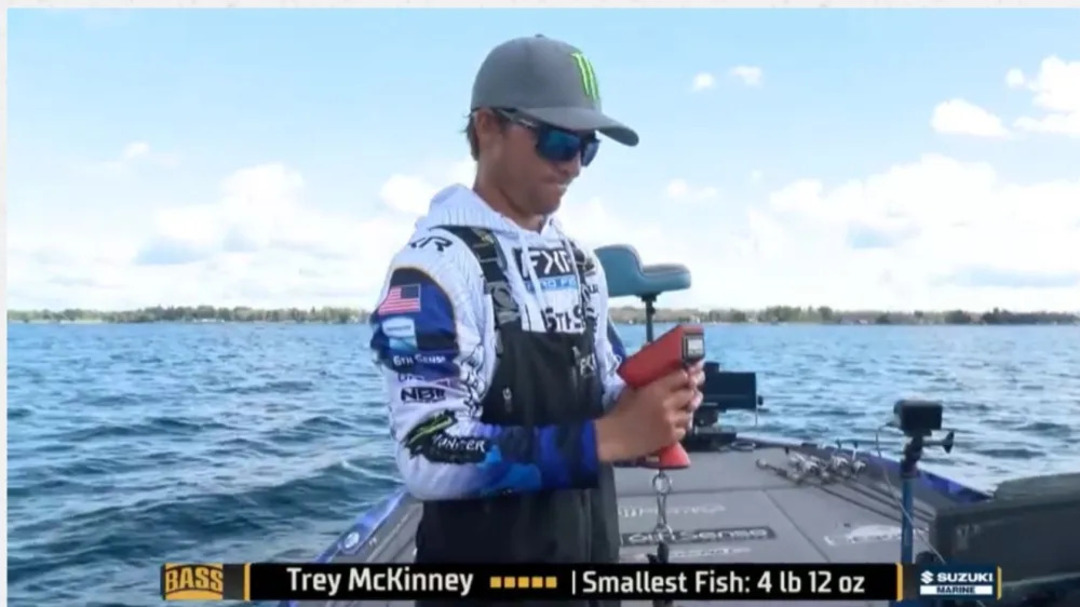
Trey McKinney smallmouth record talk is no longer about what the St. Lawrence River might produce. It already produced the kind of five-fish bag that changes a tournament, a leaderboard, and an Angler of the Year race all at once.
McKinney’s 30-pound, 11-ounce Day 2 limit pushed him into the lead with 57-3 and turned the latest stop on the bass tournament schedule from a heavy northern finale into a full stress test. The story now is not whether giant smallmouth live there. It is whether anyone can keep pace with a fishery where even elite bags can suddenly look ordinary.
Trey McKinney Smallmouth Record Changed The Whole Standard
Bassmaster described McKinney’s 30-11 limit as the biggest smallmouth bag in Bassmaster history, and the number fits the moment. The 2026 Lowrance Bassmaster Elite at St. Lawrence River had already opened heavy on Day 1, but McKinney’s second-day explosion moved the event into a different category.
His record-breaking bag did more than pass Tucker Smith’s Day 1 pace. It reset what “enough” means going into the weekend.
That is historic weight pressure. Once an angler posts 30-11 in a five-bass format, the rest of the field cannot pretend 23 or 24 pounds automatically keeps them safe. The bar moved, and it moved in public.
The Day 1 Story Became Old News Fast
Tucker Smith’s 27-5 opener was a serious lead. Bryant Smith’s 27-4 put him only one ounce behind. Ninety of 98 anglers caught at least 20 pounds, and 25 anglers reached 25 pounds or better.
That was supposed to be the shock.
Then McKinney showed what Day 2 could become.
This is the strange part about the St. Lawrence this week: the lake is producing so much weight that yesterday’s big storyline keeps getting outrun. A tournament that began as a cut-line trap has become a record chase, and the field still has to survive two more rounds.
The Day 1 analysis matters because it shows how deep the bite already was before McKinney raised the ceiling. This was not one angler finding one freak bag in an otherwise normal event. It was a heavy tournament becoming heavier.
That makes ordinary excellence a dangerous place to live.
AOY Pressure Makes The Record Bag Even Bigger
A 30-11 limit would matter in any event. It carries more weight here because McKinney entered the finale in the middle of a tight Progressive Bassmaster Angler of the Year race.
Day 1 already moved the AOY story. McKinney opened with 26-8 while other contenders had to manage both fish and risk. Bassmaster’s AOY race picture showed how quickly the standings could change, with McKinney creating space over Cory Johnston and Drew Cook after the opening round.
Day 2 made that pressure sharper.
The record bag did not just improve McKinney’s tournament position. It changed the psychological weight on everyone chasing him. A rival is not only trying to catch a good sack now. He is trying to answer a historic one.
That is AOY leverage in its purest form.
The Semifinal Decision Is No Longer Simple
McKinney’s lead gives him power, but not comfort. The St. Lawrence and Lake Ontario can give up enormous bags, and that means no one gets to coast.
The semifinal round now becomes a question of judgment. Does McKinney protect the pattern that produced 57-3 through two days, or does he keep attacking because the field can still make a violent move? Do the chasers chase another 30-pound class bag, or do they fish for enough to reach Championship Sunday?
Here is where the decision factors tighten.
| Decision Factor | Aggressive Choice | Conservative Choice | Main Risk |
|---|---|---|---|
| Leader strategy | Keep chasing giant smallmouth | Protect known water | Letting the field close fast |
| Chaser strategy | Swing for another record-class bag | Build a safe limit first | Falling too far behind |
| AOY management | Fish to win the event | Protect points position | Misreading the standings pressure |
| Big-water access | Run for the heaviest class | Stay in controlled water | Weather changing the plan |
| Fish management | Burn best areas now | Save fish for Sunday | Saving fish that never reload |
The table shows why this is no longer a simple smallmouth shootout. Every decision carries tournament value and season-long risk at the same time.
Lake Ontario Still Controls The Ceiling
The St. Lawrence River system gets the event name, but Lake Ontario remains the wild card behind much of the record talk. Anglers willing and able to reach the right water can tap into a class of smallmouth that turns a good limit into a historic one.
The danger is that big water does not care about leaderboard momentum.
Wind, waves, timing, boat control, and travel all shape whether an angler can execute. A place that produced a giant bag on Friday can become harder to manage on Saturday. A lead can shrink quickly if conditions make the best water less efficient.
That is the hidden tension behind McKinney’s record. It looks like dominance on the scale, but the lake still has enough power to make every follow-up decision feel fragile.
The Next Test Is Backing Up History
The semifinal round will tell whether McKinney’s Day 2 was a tournament-winning turn or simply the loudest moment in a week full of loud moments. There is a difference.
A record bag can create separation, but it also creates expectation. The next day tests whether the pattern still has fresh fish, whether pressure has changed the area, and whether the angler can keep making calm choices after catching the bag everyone is talking about.
For the rest of the field, the goal is no longer abstract. They have seen what the lake can give. They also know what it may require.
The Trey McKinney smallmouth record matters because it raised the finale’s stakes in every direction. It put McKinney in control, tightened the AOY drama, and warned the field that even excellent smallmouth fishing may not be enough. From here, the St. Lawrence is not just rewarding big catches. It is asking who can handle the weight of catching them again.