

Midday bass fishing can feel like a switch flips at noon: the topwater dies, the shoreline goes quiet, and the baits that worked at 8 a.m. suddenly feel invisible. The mistake is assuming bass stopped feeding; more often, the sun compressed their strike zone and exposed weaknesses in your location and presentation.
That shift belongs at the center of any serious bass fishing strategy: stop treating the clock as the problem and start reading position. Noon is a reset that rewards anglers who find the smaller, darker, better-oxygenated pieces of water where bass still have a reason to strike.
Noon Does Not End Feeding—It Shrinks the Target
Morning bass can roam. Low light lets them move across flats, chase bait along grass edges, and attack a lure from several feet away. As the sun climbs, that freedom often disappears.
Bright light sharpens shadows, improves underwater visibility, and pushes many fish closer to cover or depth. Boat traffic and repeated casts add caution. The bass may remain in the same area, but the strike zone collapses from an entire bank to one dock post, grass hole, stump shadow, or section of ledge.
That is why random lure changes rarely fix a noon slump. A different color cannot rescue a bait passing three feet outside a fish’s comfort zone. Before changing tackle, ask where a bass can sit with protection, food access, and minimal effort.
Midday Bass Fishing Starts With Repositioning
The standard advice is to “go deep,” but that is too blunt. Some bass move offshore as light intensifies. Others remain shallow because docks, vegetation, wood, or undercut banks give them cover and feeding access.
A recent bass tracking study found individual habitat preferences, with some largemouth bass favoring shallow areas and others remaining offshore. The practical lesson: do not abandon a productive morning zone until you check its nearest shade, depth change, outside edge, or isolated cover.
Follow the shortest logical move. A fish feeding on a shallow point may slide to the first break. A bass roaming a grass line may bury inside the canopy or settle on its outside edge. Fish using a dock walkway may shift beneath the darkest float. Think in feet, not miles until the evidence says the pattern has left.
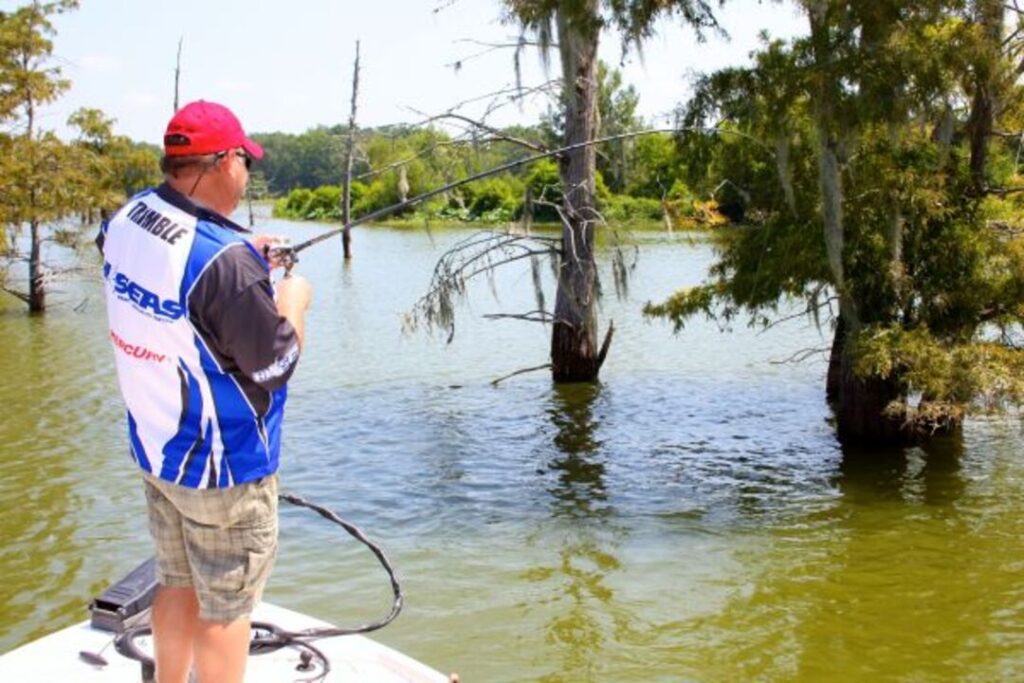
Shade Becomes Structure After the Sun Gets High
At noon, shade is a hard boundary that improves concealment and creates an ambush lane. The best shadow usually combines darkness with depth or cover.
Prioritize the darkest side of dock posts, overhangs, matted vegetation, bridge shadows, laydowns with water beneath them, and steep banks shaded at the base. A broad patch of weak shade is often less valuable than a narrow black strip beside deeper water.
Cast placement matters more than coverage. Enter the shadow quietly, let the lure settle, and keep it there. Repeated casts from different angles can reveal the opening a bass is using. Precision beats constant motion once fish tighten to cover.
Oxygen and Current Can Override the Clock
Heat and oxygen are connected, but the midday story is local. The science behind warm water and dissolved oxygen is clear: warmer water holds less oxygen than cooler water. That does not mean every shallow area is empty or every deep area is comfortable.
Current, wind, inflowing water, and healthy vegetation can improve a stagnant section. A culvert trickle, creek mouth, dam-release seam, windblown point, or green grass edge may hold feeding fish while nearby water appears lifeless. Deep water can also be unproductive when it sits below a summer thermocline with poor oxygen.
Look for movement before depth alone. Baitfish facing current, drifting debris, greener vegetation, or a temperature change near an inflow can identify a productive lane. Moving water changes the schedule because it delivers oxygen and food while reducing the effort needed to feed.
Match the Presentation to the Fish’s New Address
Use the first strong midday clue to choose a location and presentation instead of cycling through the entire tackle box.
| Midday clue | Likely bass position | First adjustment | Backup move |
|---|---|---|---|
| Hard sun and calm water | Tight to deep shade or cover | Quiet pitch with a compact jig or worm | Skip a weightless plastic under cover |
| Current begins moving | Current seam, point, or downstream edge | Swim a jig, crankbait, or spinnerbait | Drag a bottom bait behind the break |
| Bait suspends offshore | Ledge, hump, brush, or channel edge | Count down a swimbait or use a drop shot | Slow-drag a football jig |
| Thick grass tops out | Under the mat or on the outside edge | Punch, flip, or work a frog | Probe the edge with a Texas rig |
| Heavy boat pressure | Less obvious cover or deeper structure | Downsize and make longer casts | Return after traffic shifts |
The table reveals two useful lanes. Force a reaction by deflecting a bait off cover, ripping it free from grass, or moving it through current. Or make the meal effortless with a worm, jig, drop shot, or compact plastic that stays in place.
The wrong move is slowing down everywhere without confirming fish are present. Slow baits work because they remain inside a small strike zone, not because noon makes every bass lethargic.
Small Signals Can Reopen the Bite Fast
A dead hour can change in minutes. A cloud blocks the sun, a breeze reaches a protected bank, dam generation begins, shade slides across a key post, or bait rises over a point. Those details are permission to fish faster and widen the search.
Watch the lake instead of waiting for a clock-based afternoon bite. If wind breaks the surface, revisit shallow cover with a moving bait. If current starts, move to the first obstruction that concentrates it. If a dock shadow shifts, target the newly darkened side. Under heavy traffic, approach quietly and make the first cast count.
Midday bass fishing becomes manageable when you stop trying to revive the morning pattern. The opportunity is not in making bass behave as they did at sunrise. It is in finding where light, oxygen, current, cover, and pressure have pushed them now—and placing one convincing lure inside the smaller window they are still willing to defend.